
More than 130 years have passed since Ukrainians began emigrating in large numbers to countries in Latin America such as Brazil. Today, their descendants are scattered across territories spanning two continents—South and North America—and speak languages that rank second (Spanish) and sixth (Portuguese) in the world in terms of native speakers. The newcomers brought with them the language of Taras Shevchenko, and over time monuments were erected in his honour in Argentina, Brazil, and Paraguay. In two municipalities south of the Equator—Prudentópolis and Mallet in Brazil—Ukrainian has even been declared a co-official language by municipal law. This presentation traces the history of an immigration that brought up to 180,000 Ukrainians to countries south of the United States in several distinct waves, as well as the contemporary life of Ukrainian communities that today together number more than one million people, including both immigrants and locally born descendants.
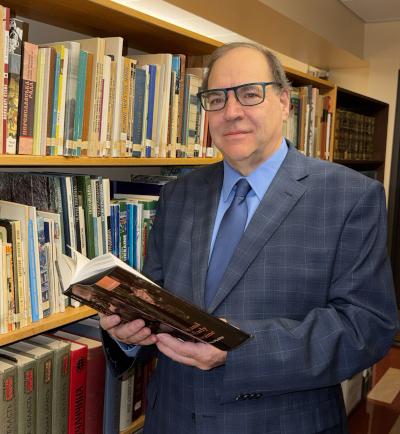
Serge Cipko is Assistant Director, Research, at the Canadian Institute of Ukrainian Studies, University of Alberta. He has authored many works on the Ukrainian diaspora and related topics, including Ukrainians in Argentina, 1897–1950: The Making of a Community (CIUS Press, 2011; translated into Ukrainian and Spanish) and, in Spanish, “El Año 1933”: El Holodomor y sus reverberaciones en la Argentina (Buenos Aires: Editorial Antigua, 2023) [“The Year 1933: The Holodomor and Its Reverberations in Argentina”] and Los ucranianos en la República Oriental del Uruguay: Una Historia (Buenos Aires: Editorial Antigua, 2023) [Ukrainians in the Oriental Republic of Uruguay: A History].