
In 1989, Ukrainians began a fourth wave of immigration to the U.S which continues today. It was accelerated by the declaration of Ukrainian independence as a new state in 1991. In 2000, there were 6,602 fourth-wave immigrants in New Jersey. The number of Ukrainians in the state declined from 81,020 in 1980 to 66,638 in 2010. In 2025, there were 73,809 Ukrainians in the state probably due to the arrival of refugees from the Russian war against Ukraine (2022-present). By 2010, there was an estimated total of about 250,000 fourth-wave immigrants in the U.S.Wolowyna, Oleh. Atlas of Ukrainians in the United States. New York, New York. Shevchenko Scientific Society, 2019. pps. 25-27, p. 51.
The fourth-wave immigration can be characterized overall as “voluntary economic” although it is questionable whether the recent refugees would have emigrated to the U.S. without the war.In fact, some consider the refugees who have arrived starting in 2022 to be a ‘Fifth Wave’. Since April 2022, the Uniting for Ukraine (U4U) program has allowed U.S. citizens and organizations to sponsor Ukrainian individuals and families displaced by the war. By September 13, 2022, 7,293 people in New Jersey had applied to financially sponsor Ukrainian war refugees.CBS News. “5 states account for half of 123,962 requests to sponsor Ukrainian refugees in U.S.” (September 13, 2022) As of March 6, 2025, a total of 240,000 Ukrainians were resettled in the U.S. according to the Reuters news agency.
There is some question whether Ukrainian war refugees will continue to be able to settle in the U.S. and New Jersey. The U4U program is not accepting new applications as of January 27, 2025. U.S. Citizenship and Immigration Services (USCIS) paused the program while the new Trump presidential administration reviews humanitarian parole programs. No additional information about the program’s continuance is available currently (February 2025).
Since late 2022, Razom for Ukraine has helped displaced Ukrainians arriving in New Jersey. Razom was born out of the Ukrainian Revolution of Dignity in 2014. The non-profit organization works actively in the U.S. and Ukraine to help build a secure, prosperous, and democratic Ukraine. In Jersey City, the fourth generation Ukrainian American Tamara Syby-Holovko is the Razom project lead for the Ukraine response initiative and welcome center in the New York City area. She is also the refugee coordinator for the organization Ukrainian Jersey City and a vice president with the local branch of the Ukrainian Women’s League of America (UNWLA). Tamara’s Ukrainian ancestors settled in Jersey City more than 100 hundred years ago! Razom has become an important part of the fabric of Ukrainian American community life during the fourth wave of Ukrainian immigration.
War and refugees
On February 24, 2022 the unthinkable happened: Russia invaded Ukraine. Despite many signs that the attack was imminent, the government of Ukraine could not accept the idea that Russia would attempt to capture Kyiv in four days and indeed subdue the entire country. Russian President Vladimir Putin wanted nothing less than to annihilate Ukraine as an independent state and as a nation. And three years later, the war continues.
As the fighting grew between Russian and Ukrainian forces and the physical destruction of towns and villages grew more widespread, Ukrainian citizens from the eastern regions where much of it took place began to head west. European countries, especially Poland, accepted large numbers of mostly women and children from Ukraine. According to Statista, which is a global data and business intelligence platform, as of February 2025 there were an estimated 6.8 million Ukrainian refugees recorded globally since February 2022 with the majority in Europe (6.3 million). Germany had the highest number with 1.2 million, followed by Russia also with 1.2 million (probably many are forced evacuees from the occupied territories of Ukraine) and Poland had 993,795.Statista, “Ukrainian refugees by country”, March 5, 2025. The United Nations Refugee Agency says there are 3.7 million internally displaced people within the borders of Ukraine (mostly in Western Ukraine).
As mentioned previously in this article, by September 13, 2022, 7,293 people in New Jersey had applied to financially sponsor Ukrainian war refugees.CBS News. “5 states account for half of 123,962 requests to sponsor Ukrainian refugees in U.S.” (September 13, 2022) And as of March 6, 2025, 240,000 Ukrainians had resettled in the U.S. since Russian invasion began.
A fourth generation Ukrainian American in Jersey City helps Ukrainian war refugees
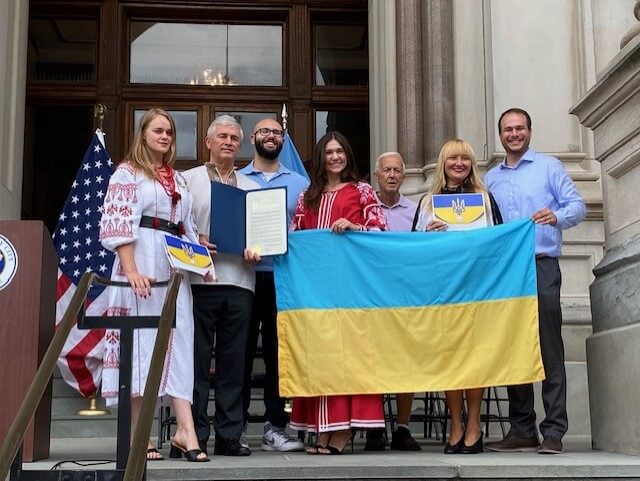
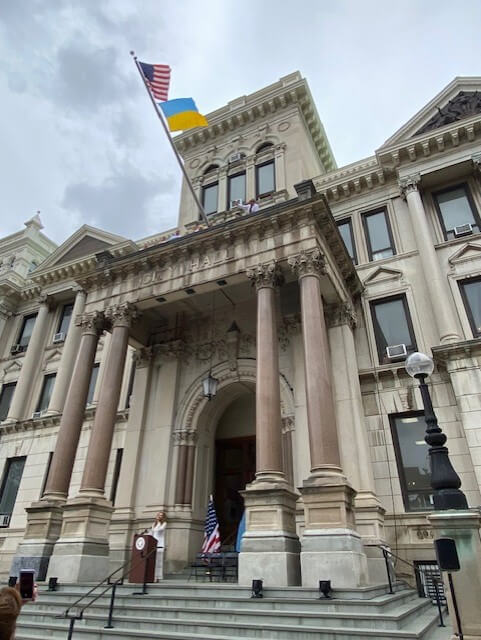
Jersey City Hall with Ukrainian flag on August 24, 2023
Ukrainian Jersey City and Razom for Ukraine are two organizations that are helping Ukrainian war refugees in New Jersey. Tamara Syby-Holovko, a fourth generation Ukrainian American who lives in Jersey City, is actively involved in both organizations.Buryk, Michael. The Ukrainian Weekly, Krynytsya (The Well) podcast interview. “Tamara Syby-Holovko talks about her work with Ukrainian war refugees in the New York area”, February 13, 2024.
Her great grandparents came from Ukraine in the first wave of immigration and settled in Jersey City and started stores in the Heights section and Downtown. “My great uncle kind of did the same thing that my mom and me did by helping people from Ukraine”, said Tamara. “He would go to Ellis Island when people came in from Ukraine and take them to live in our house where I still live today. He helped them and supported them when they came. They were very new arrivals in America, and we still know almost all those people that came then, and they’re still friends with us today”.Buryk, Michael. The Ukrainian Weekly, Krynytsya (The Well) podcast interview. “Tamara Syby-Holovko talks about her work with Ukrainian war refugees in the New York area”, February 13, 2024.
Ms. Syby-Holovko first started with Razom as a volunteer. Razom (which means “together”) is a U.S.-based 501(c)3 organization which seeks to uphold the principles of the Revolution of Dignity and to help build a secure, prosperous, and democratic Ukraine. Since the beginning of the Russian war against Ukraine, it expanded its work, providing critical humanitarian aid to Ukrainians affected by the invasion. With its presence in New York and the metropolitan area, the organization received a grant from Mayor Adams in July 2022 to help refugees and displaced persons who came from Ukraine with benefits and all the paperwork that they would need to survive here.
In February 2024, Tamara was the Hudson County refugee coordinator for Razom responsible for more than 580 families that have come to Jersey City. She was also working as the refugee coordinator for Ukrainian Jersey City, which began as a cultural organization but now is also involved in humanitarian services. The Jersey City Ukrainian war refugees came primarily from the occupied territories of eastern Ukraine, but there are Western Ukrainians among them as well. 38-year-old Liudmylo Holovko and her 4-year-old daughter Nicole left Lviv, Ukraine, shortly after the war began while her husband stayed behind to fight.The Star-Ledger (Newark, NJ) “Far from war’s madness, a temporary oasis”, September 4, 2022, p. A1. Liudmylo is Tamara’s sister-in-law. She and her daughter are gradually adjusting to life in Jersey City with the help of her sister-in-law.
Ms. Syby-Holovko talks about the greatest challenge for Ukrainian refugees here. “The greatest challenge is the psychological and mental strain they’ve had since they came from war to America … even though they seem normal to you and me when they speak, it’s very hard for them to come here and try to adjust to a new language, a new life, a new way of living. It’s very, very hard, and so that’s the most difficult thing for us and for them that they had to go through from the beginning when they came here.”
Under the current presidential administration at the time of this writing, no one knows whether the U4U program that has assisted Ukrainian war refugees and allowed them and their families to temporarily stay in the U.S. will continue. On Monday, January 27, 2025, U.S. Citizenship and Immigration Services (USCIS) announced that no new applications for the program would be accepted pending the Trump Administration’s review of all humanitarian parole programs.Ukraine Immigration Task Force web site. “USCIS Officially Pauses Uniting for Ukraine (U4U) Applications and Ukrainian Re-Parole until Further Notice”, January 27, 2025. The question of what will happen to the more than 240,000 Ukrainians who have come to the U.S. since February 2022 is unresolved.Reuters. “Trump weighs revoking legal status of Ukrainians as US steps up deportations”, March 6, 2025. The immigration status of Ukrainian war refugees in New Jersey remains in limbo for now.
Humanitarian aid and fund-raising
After the initial shock of Russia invading Ukraine on February 24, 2022, Ukrainian American individuals and organizations opened their hearts and their checkbooks to deliver humanitarian aid and create fund-raising events. Many members of the community took part including churches, schools, community centers, non-profits and businesses.
In early March 2022, UACCNJ launched a fund-raising effort to aid Ukraine in its struggle with Russia. In addition to this effort, Jerry Kuzemczak, a UACCNJ trustee, said that the center shipped its first cargo of humanitarian aid to Ukraine. He pointed out that Ukrainian youth volunteers working in the parking lot collected more than 600,000 pounds of aid and filled 12,000 boxes over two weekends and shipped this to Ukraine at a cost of $66,000.The Star-Ledger (Newark, NJ) “Groups collecting aid for Ukraine have one big need: Money for shipping costs”, March 13, 2022, p. A17.
Churches and organizations
Many Ukrainian churches in the Garden State launched relief efforts for Ukraine shortly after the Russian invasion. The Ukrainian Orthodox Church of the USA headquartered in South Bound Brook/Somerset, for example, launched a major appeal, raising nearly $2.5 million and releasing over $1 million of that by September 2022. This effort has been ongoing and continues through the time of the publication of this resource in 2025.
Individual parishes also engaged in humanitarian aid and fund-raising. For example, by May 2022, St. Nicholas Ukrainian Catholic Church in Passaic raised enough money to donate two ambulances that were sent to Kramatorsk and Andviika on the front lines in eastern Ukraine. “If they can save just one life of a husband, a brother or a son it’s just one of our contributions to the effort,” said parishioner George Oliarnyk, a second generation Ukrainian American. Many other Ukrainian churches had relief efforts including St. Stephen Ukrainian Catholic Church in Toms River and St. John the Baptist Ukrainian Catholic Church in Newark.
Organizations participating in humanitarian war relief efforts for Ukraine include: the New Jersey chapters of the Ukrainian Congress Committee of America, the Ukrainian Women’s League of America (UNWLA), the Ukrainian American Youth Association, the Plast branch in Newark, and others. In addition to these numerous relief efforts, Ukrainians in New Jersey organized prayer vigils through their parishes and participated in rallies and demonstrations on a local and national level in Washington, D.C. Recognizing the importance of the Ukrainian American community in the state, New Jersey politicians were especially supportive of Ukraine during this time.
Meest: Shipping humanitarian aid to Ukraine
Meest was founded in Canada in 1989 as an international shipping company serving 75 countries including Eastern Europe. Meest-America was established in 1995 with its headquarters in Port Reading, N.J. and a large warehouse in Woodbridge. After the Russian invasion of Ukraine, Meest-America was forced to pivot from its primary business, which dropped by 85%, and become an essential link for the transport of humanitarian supplies to Ukraine for the U.S.
Ms. Natalia Brandafi, who came to the U.S. in 1993 from the Ivano-Frankivsk region of Western Ukraine and is the COO of the company, said: “Within a couple of days (of the invasion), we reorganized our operations to ship relief supplies. For the first three weeks, we were receiving deliveries of charity cargo almost every 15 minutes. We operated seven days a week.”Buryk, Michael. The Ukrainian Weekly, Krynytsya (The Well) podcast interview. “War in Ukraine: Natalia Brandafi describes role of Meest-America in humanitarian relief”, May 11, 2022. On March 13th, Myroslava Downey, a company spokeswoman said: “Our warehouse is completely full now.” The company was shipping humanitarian aid to Ukraine at a deep discount with the help of about 60 volunteers in addition to its own staff. As a for-profit company, Meest-America could not accept financial donations, but it encouraged donors to send shipping donations to the non-profit Razom.The Star-Ledger (Newark, NJ) “Groups collecting aid for Ukraine have one big need: Money for shipping costs”, March 13, 2022, p. A17. Razom also became one of the main organizations using the company to send humanitarian aid to Ukraine.
Ms. Brandafi pointed out the major challenge for the company as the volume of aid shipped increased. “Well, within the first week of the war, we lost almost all our revenue. So, within a couple of days, we (re)organized our operations from shipping parcels to handling about 250,000 pounds of relief supplies weekly. So, at the same time, we had to work on fundraising daily to cover the cost of transporting humanitarian aid. The loss of revenue was the biggest blow to us. This was both our greatest success and our greatest challenge.”Buryk, Michael. The Ukrainian Weekly, Krynytsya (The Well) podcast interview. “War in Ukraine: Natalia Brandafi describes role of Meest-America in humanitarian relief”, May 11, 2022.
“Hope for Ukraine”

In 2016 Yuriy Boyechko and his brother Yaroslav established Hope for Ukraine (located in Roseland, N.J.) in response to the annexation of Crimea and what happened in Donbas region. “We wanted to start this to help the refugees at that time, and we saw a need for medical treatment for children in Ukraine. There’s a lot of kids who have treatable conditions, but because of lack of funding, you know, the parents could not afford [it],” said Mr. Boyechko.Buryk, Michael. The Ukrainian Weekly, Krynytsya (The Well) podcast interview. “War in Ukraine: non-profit Hope for Ukraine delivers humanitarian aid to Ukraine during war”, December 13, 2022.
Before the Russian invasion of Ukraine in February 2022, Hope for Ukraine was involved in a variety of projects including family support through clothing, food and shelter, children’s medical care, help for refugees and others. Once the invasion happened, the organization adapted its mission to include non-military ad for frontline Ukrainian combatants such as food and essential clothing items. The group has about 100 volunteers in Ukraine.Buryk, Michael. The Ukrainian Weekly, Krynytsya (The Well) podcast interview. “War in Ukraine: non-profit Hope for Ukraine delivers humanitarian aid to Ukraine during war”, December 13, 2022.
Hope for Ukraine also made monthly food distribution to internally displaced people in Lviv and other Western Ukrainian towns who were basically living out of their suitcases. By December of 2022, the organization had shipped about 400 tons of humanitarian aid in total.
Among the many Ukrainian American donors to this effort was Stephanie Gaber, a resident of Brandywine Living in Princeton who has cousins in Ukraine. She organized a benefit fundraiser for Hope for Ukraine in the spring of 2022 that raised $2,643.20 that went to buying food for Ukrainian refugees.The Star-Ledger (Newark, NJ) “Assisted living residents themselves assist Ukraine”, April 4, 2022, p. A2. “It turned out to be a great day,” said Stephanie.
In addition to its major humanitarian aid effort, Hope for Ukraine and HUMANITE Canada Peace Collected worked together in the fall of 2024 to sponsor the North American East Coast charity tour of the National Ballet of Ukraine. The tour came to the Bergen County Performing Arts Center in Englewood PAC on Oct. 12th, the State Theatre in New Brunswick on Oct. 13th, and the Count Basie Center for the Arts in Red Bank on Oct. 14th. “For the entire Ukrainian community, it’s a ray of light, a ray of joy and a ray of hope,” said Yuriy Boyechko.The Courier-News. “National Ballet Company of Ukraine keeps country’s ‘unbreakable spirit’ alive”, October 11, 2024, p. W2.
Unfortunately, in January 2025, the Trump administration abruptly ended U.S. foreign development aid through the United States Agency for International Development (U.S.A.I.D.).
The U.S. has provided more than $37 billion in humanitarian aid, development assistance and direct budget support since the war began. Mr. Boyechko said that the cessation of U.S. aid to Ukraine was felt immediately. He had worked with U.S.-funded groups supplying firewood to people on the frontline of the war. “This is just extremely harmful (in the middle of winter) because you have millions of people in frontline areas near Kherson and Kharkiv who have been living without light for a long time. For them, firewood has been the only source of heat and a way to prepare food,” he said in a NY Times interview published in January 2025.The New York Times, New York, N.Y. “Many Ukrainian Aid Groups Stop Work After Trump’s Halt on Foreign Assistance”, January 29, 2025, Section A, p. 5. U.S. aid to Ukraine is still cut off as of March 10, 2025.