Ruthenians from Galicia first arrived in the Millville area (near Vineland, Cumberland County) during 1910-1912. Encouraged by a real estate development ad in Svoboda, they bought land there and began farming. The community had its ups and downs, but today many Ukrainians still call it home. Sts Peter and Paul Ukrainian Orthodox Church (1917) and St. Nicholas Ukrainian Catholic Church (1918, 1939) continue to serve the faithful there.
After World War II in 1953, a group of Cossacks from the Kuban region of Russia established a settlement in rural Buena Vista Township not far from Millville which they named “New Kuban”. The Kuban region of Russia has a long history of ties to Ukraine. In 1792, the Russian Empress Catherine the Great gave the lands on the right bank of the Kuban River to the Ukrainian Black Sea Host of Kozaks. This group had been created in 1787 from former Zaporizhian Kozaks. The Ukrainian population of the Kuban region continued to grow into the 20th century. A Kuban People’s Republic was declared in January 1918 and sought to unite with the Ukrainian People’s Republic. It was annexed by the Soviets in 1920. After a period of Ukrainianization under the Soviets, this program was outlawed in 1932, and Ukrainians experienced an oppressive policy of Russification by the government.
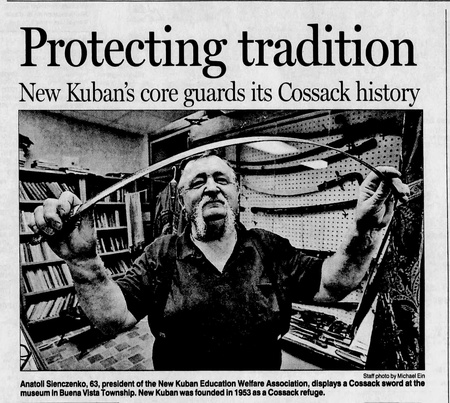
Anatoli (Tony) Sienczenko
Tony Sienczenko (the surname was originally “Zienczenko”) was born in the Kuban region of Russia in 1950. In 1957, he and his family moved to Ukraine where his mother had been born in 1926. She was a Polish citizen since the place in Western Ukraine where she was born was within Poland’s borders then. In 1958 the family was able to move to Poland. Eventually they left for the U.S. and lived in Pennsylvania and New York state until 1970 when Tony decided to take a federal job as a meat inspector in Vineland, New Jersey. In 1973, he met a resident of the New Kuban settlement whom he liked immediately and decided to move there and build a house. He and his family have been there ever since.Buryk, Michael. The Ukrainian Weekly, Krynytsya (The Well) podcast interview. “New Kuban Kozaks Interview”, September 5, 2019. Mr. Sienczenko eventually was elected “ataman” (head or chief) of the New Kuban Cossack community in 1986 and took over permanently in 1988.
Tony is president of the New Kuban Education and Welfare Association in Buena Vista. The association holds an annual September barbeque event to fundraise for the group and to share their Cossack traditions. He is also curator of the New Kuban Historical Museum dedicated to Cossack artifacts which is open to the public by appointment. Mr. Sienczenko hosts many school groups at the museum including some from Ukrainian school in Philadelphia. The community center and the museum were established in the 1970’s. Mr. Sienczenko is proud of his Ukrainian and Kozak roots.The Press of Atlantic City, Atlantic City, N.J. “Protecting Tradition: New Kuban’s core guards its Cossack history”, April 22, 2013, p.1. He is an active member of Sts. Peter and Paul Ukrainian Orthodox Church (Millville) where he received an award in July 2021 from the Council of Bishops of the UOC of the USA in recognition of his dedicated service to the church.
Ataman Sienczenko worries about the New Kuban community and its declining number of families each year. But he hopes that his son Anatoli Jr. will one day take over responsibility as the curator of the New Kuban Historical Museum and keep the memories, stories and traditions of the Kuban Cossacks alive. New Kuban is a unique and unusual part of the Ukrainian American community in New Jersey.