The Ukrainian Village
Although there had been Ukrainian Americans living in the area around New Brunswick and Bound Brook for many decades, their population was relatively low and it was not a major center of community life. This changed in a big way around 1950, when the St. Volodymyr Ukrainian Orthodox Cathedral on W. 82nd Street in New York City decided to purchase a tract of land in Somerset for use as a summer retreat. They named it the “Ukrains’ke Selo” (“Ukrainian Village”), and it quickly became a major social center during the summer months.
In its heyday in the 1950s and ’60s, each weekend would bring music, dances, and outdoor activities. Given its central location, it attracted visitors by the busload not only from New York City and its suburbs, but also from Philadelphia and beyond. There were opportunities for camping or bungalow rental.Michael Serheev oral history interview. 2024. Ukrainian History and Education Center Archives; Valentina Syzonenko oral history interview. 2025. Ukrainian History and Education Center Archives.
Although it continued to be used for recreation and St. Volodymyr Cathedral parish events, the bungalows were eventually replaced by townhouse-style residences. Today, the Ukrainian Village consists almost exclusively of such residences, primarily inhabited by Ukrainian American senior citizens, along with a few remnants of its former history.
The Metropolia Center of the Ukrainian Orthodox Church of the USA
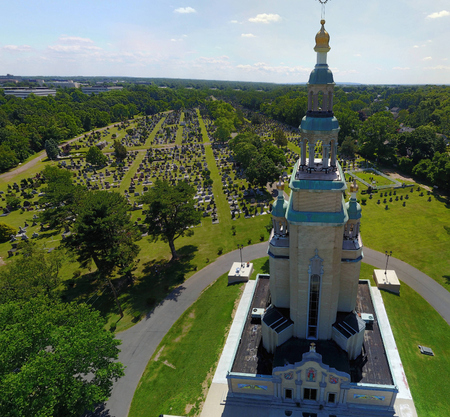
Aerial view of St. Andrew Memorial Church and St. Andrew Cemetery
Located not far from the Ukrainian Village is the national headquarters of the Ukrainian Orthodox Church of the USA. It is on a substantial property along Easton Avenue north of Interstate 287 along the Somerset/South Bound Brook boundary. Since the purchase of the initial parcel in 1951, it has become a major epicenter for Ukrainian American life in New Jersey, the Mid-Atlantic region, and far beyond. In addition to its major architectural and sculptural monuments, it has the largest predominantly-Ukrainian cemetery outside of Ukraine. Untold thousands of Ukrainian Americans; Ukrainian and American Presidents, legislators, and government officials; and people of all faiths and ethnicities have walked this property and entered its buildings and institutions. It also happens to be the physical home of the Ukrainian History and Education Center.
The UOC of USA’s choice of Franklin Township/South Bound Brook for this site may seem a bit puzzling. As mentioned, the concentration of Ukrainian Americans in the area was relatively low, and there were already major, long-established Ukrainian Orthodox parishes in places like Newark, Trenton, Bayonne, and Carteret. There were multiple factors that contributed to the choice. The price of real estate was certainly an obvious consideration. Given that this was still very much a rural area in the 1950s, it probably was much cheaper than a comparable property closer to a city. The connection to America’s colonial and revolutionary past (see below) also played a role in the decision to purchase the property. Its location fit nicely into the ecclesiastical geography of the UOC of the USA: it was located roughly midway between the cathedral of Metropolitan John (Teodorovych) in Philadelphia and that of Archbishop Mstyslav (Skrypnyk) in New York City — two of the major eparchial centers in that period. The presence of the nearby Ukrainian Village also played a significant role in convincing the Church leadership to support the purchase of the property. In fact, the meeting of the Metropolitan Council (the executive committee of the Church’s board) at which the purchase was approved actually took place at the Ukrainian Village.
The Metropolia Center’s “pre-Ukrainian” past
The grounds of the Metropolia Center are embedded in the wider history of Ukrainian Americans in New Jersey, as well as the history of the state in general going back to the Colonial period.
The earliest recorded European owner of the ancestral lands of the Lenape People where the UOC Metropolia Center is now located was a London merchant originally from Scotland named William Dockwra. In 1682, he obtained 900 acres of land along the Raritan River from the Proprietors of the colonial Province of New Jersey which he parceled out to settlers, primarily from Holland.
Hendrick Fisher: Underappreciated patriot
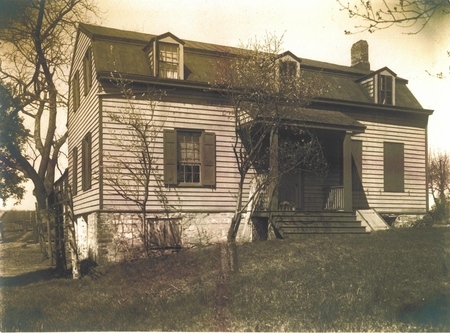
Historical view of the Fisher House
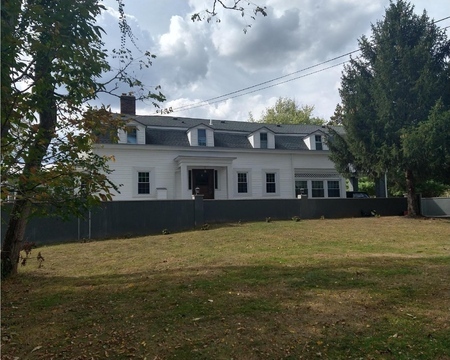
View of the Fisher House in 2025
One parcel of 300 acres was purchased from Dockwra in 1703 by Hendrick Fisher (originally Visscher), who had arrived in North America with his young family from the Palatinate, likely via Holland. The Palatinate, located west of Frankfurt and south of Bonn along the Rhine River, was and still is a relatively sparsely-settled area of Germany. The Fishers were Reform Protestants, and they were among many Palatine Germans facing religious persecution who emigrated to New Jersey and Pennsylvania (where they became known as the “Pennsylvania Dutch”).
The Fisher family, which included a young son also named Hendrick (born 1697), settled in what is now known as the Fisher House, though it has been so extensively modified over the subsequent centuries that the original Colonial-era structure is nearly invisible today. There is some uncertainty about when that original building was built. Some sources say that it was built in 1688 by William Dockwra. Others claim that Dockwra never actually came to New Jersey but managed his holdings from London as an absentee landlord. If that is the case, then the house was likely built somewhat later by either the elder or younger Hendrick Fisher.
Almost nothing is known about the elder Hendrick Fisher or most of the rest of his family. On the other hand, the younger Hendrick would play a significant but underappreciated role in the civic and political life of 18th century New Jersey.Rev. T. E. Davis, Hendrick Fisher. Proceedings of the New Jersey Historical Society (Third Series, Volume 4, No. 3, 1904-1905). He was one of three delegates from New Jersey to the Stamp Act Congress of 1765, served on New Jersey’s Committee of Correspondence and Committee of Safety, was President of the New Jersey Colonial Assembly, and was the first President of the Provincial Congress (the predecessor of the New Jersey Legislature). Both he and his neighbor Abraham Staats were declared traitors and “Enemies of the Crown” for their revolutionary activities.
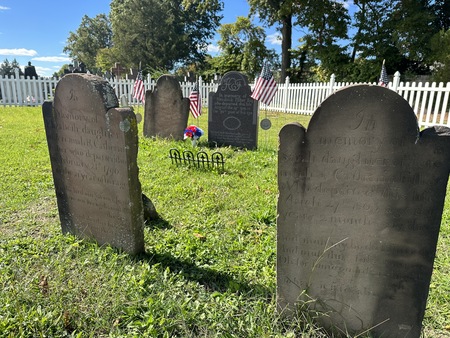
A portion of the Fisher Family graveyard
While he was not a delegate to the Continental Congress of 1776, he was present in Philadelphia and brought back a copy of the Declaration of Independence, which he read to assembled community members in Bound Brook. Unfortunately, he did not live to see American independence fully realized: the outcome of the Revolutionary War was far from clear when he died in 1779. He and other members of his family were buried in a family plot on his estate. That Fisher Family graveyard is now surrounded by the much larger St. Andrew Cemetery.
In addition to his political activities, he was also ordained as a lay preacher in the Reformed Church to assist the badly overstretched Rev. Theodore Frelinghuysen (who was pastor of five churches spread out over nearly a 10 mile radius between North Branch and New Brunswick). He also played a critical role in the founding of Queens College (now Rutgers University) in New Brunswick, becoming the first President of its board of trustees.
Frederick Rossman: Gentleman farmer
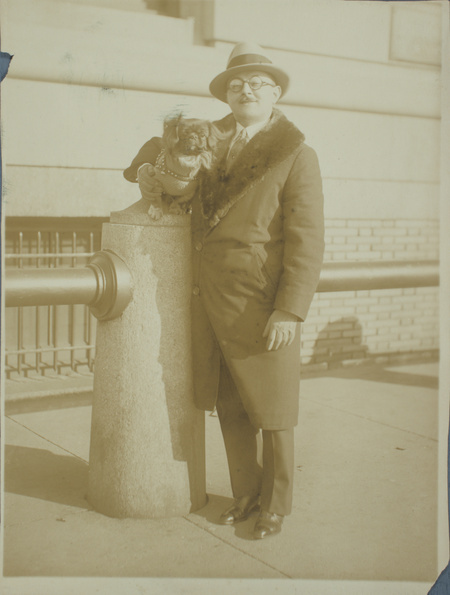
Frederick Rossman
In 1951, the Metropolitan Council of the Ukrainian Orthodox Church of the USA adopted a resolution to purchase 57 acres of the land that had long ago been owned by Dockwra and Fisher, but which by then was owned by Frederick L. Rossman. The deed of purchase of the property includes a list of farm equipment, so the land was clearly agricultural. However, the owner was very likely not the person doing the actual farming.
Photographs of him suggest a well-to-do city-dweller, and he was in fact a successful stock broker working on Wall Street. He almost certainly did not grow up rich, though. He was born in 1892 in the Kingdom of Hungary, came to the US in 1908 with his parents Joseph and Tecla, and settled in St. Louis, Missouri. By 1910, Frederick was living with his mother and younger sister and working as a salesman for a wire company.
Soon after, he and his mother moved to New York City. On his 1917 draft registration card, he listed his occupation as “importer”, and by the time of the 1920 Census he was a Vice President of a bank. In 1928 he was a junior partner in the newly-formed Wall Street firm of Schatzkin & Co., and in 1936 he founded his own firm of F. L. Rossman & Co.
In 1932, Rossman purchased the property that would eventually become the nucleus of the Metropolia Center. The 1940 Census shows him, his wife, and his mother living at 1 Easton Avenue (as it was numbered by the census taker), presumably in the Fisher House. Neither he nor any family members were living there when the 1950 Census was taken. His obituary that ran in the New York Times on November 18, 1974 says that he had only recently retired as senior partner of the Wall Street firm Rossman, Gary & Co., that he lived on 5th Avenue and 74th Street in a building overlooking Central Park, and that he also had a home in Tinicum, Pennsylvania.
The Hetherington House
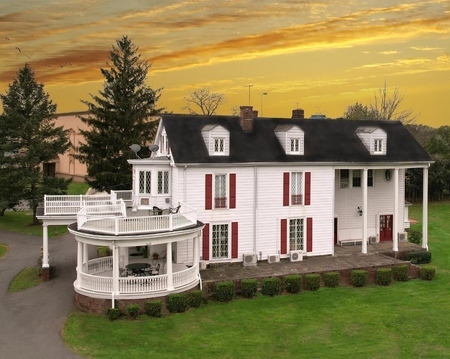
View of the Hetherington House (now the St. Sophia Seminary building of the Ukrainian Orthodox Church of the USA)
The property along Davidson Avenue, including the Colonial Revival-style building that now houses St. Sophia Seminary, was purchased by the UOC of the USA in 1972 from the estate of Gladys Hetherington, the widow of Arthur F. Hetherington Sr. Like his neighbor Frederick Rossman, Arthur Hetherington also worked on Wall Street, but he was a significantly bigger fish. He was not just a stock broker, but was actually a member of the New York Stock Exchange.
Arthur’s father James A. Hetherington was a successful New York City druggist. His store, established in 1876, was in a prime location: directly opposite the Grand Central Depot of the Harlem Railroad (replaced by Grand Central Terminal in 1913). He was apparently sufficiently well-off that he was able to send his son to Harvard. After graduating in 1908, Arthur founded the firm Hetherington & Co., then in 1922 became a partner of the brokerage firm De Coppet & Doremus. By the 1930s, he was sufficiently prominent that he testifіеd before the House Committee on Interstate and Foreign Commerce during the drafting of what would become the landmark Securities Exchange Act of 1934. In 1943, he became a limited partner of the firm Goodbody & Co.
It’s possible that the building that now houses the Seminary was the Hetheringtons’ “country home” and that they also had a residence in Manhattan. However, when they were mentioned in the New York Times society pages, it was often as “Mr. and Mrs. A. F. Hetherington of Bound Brook”. In the 1950 Census, they are listed as living there along with three maids: Louise Sandell (born in New York), Philomena Carewe (born in Newfoundland, Canada), and Mary Ryan (born in Ireland).
Early development of the Metropolia Center
At the time of the first purchase from Rossman, the property had, in addition to the Fisher House (which became the Consistory building and Archbishop’s residence), it had a building that started out life as a colonial Dutch-style barn, a building that became a printing shop, and a small home. A former mill building that had been converted into something like a guest house near the creek and dam was turned into a chapel, community center, library, archives, and school. That building unfortunately burned down in 1964.
Read journal entries of a resident of the mill building in 1959
St. Andrew Cemetery
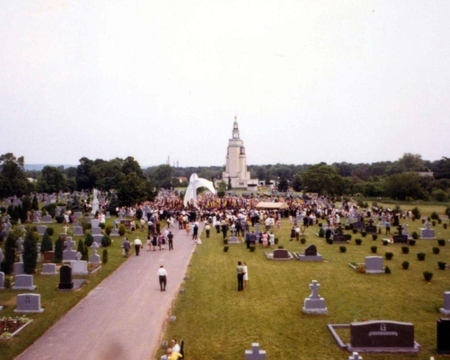
Dedication of the large central cross at St. Andrew Cemetery, 1971
Efforts began almost immediately after the purchase of the property to establish St. Andrew Cemetery. This was facilitated by another major advantage of the property: it had the Fisher Family Graveyard that dated back to the late 1700s. Since there were already human burials on the property, that greatly eased the approval of cemetery plans by the Franklin Township authorities. Those authorities may not have fathomed that this cemetery would eventually become the largest predominantly-Ukrainian cemetery outside of Ukraine.
Since its opening in 1954, the cemetery has been the site of burials of some extremely prominent artists, writers, scholars, politicians, and soldiers from Ukrainian history. It is also a site of memory for the thousands of “ordinary” Ukrainian Americans buried there. They or their families chose St. Andrew Cemetery as a burial place because this site had become the center of a real and virtual Ukrainian American community spanning far more than just New Jersey or the Mid-Atlantic region, but also including far-flung states and countries as far away as Venezuela. Some of these burials feature quite astounding and elaborate monuments, including ones designed by known Ukrainian American artists. The cemetery has even been featured in cemetery monument trade journals for this reason.
St. Andrew Memorial Church
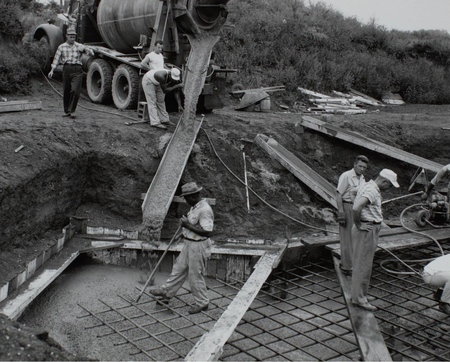
Pouring of the foundation of St. Andrew Memorial Church
In 1955, construction began on St. Andrew Memorial Church as a monument to those who perished in the genocidal artificial famine of 1932-33 known as the Holodomor, and those who have given their lives for the cause of freedom and justice in Ukraine. Construction continued for ten years and the Church was consecrated in October 1965.
The building was designed by the Ukrainian Canadian architect Yurii Kodak (1916-1991, born Yurii Panasenko), it is in his characteristic style that fuses the Ukrainian Baroque of the 17-18th centuries with 20th century interpretations and materials. The iconostasis (icon screen) and side icons are the work of the Ukrainian neo-Byzantine artist and iconographer Petro Cholodny, who is buried nearby in the front row of St. Andrew Cemetery. He is the son of Petro Cholodny the Elder, who served as Minister of Arts and Education in the Ukrainian People’s Republic.
Provody
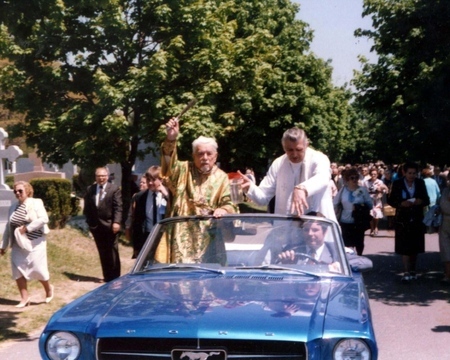
Metropolitan Mstyslav blessing graves on St. Thomas Sunday Provody
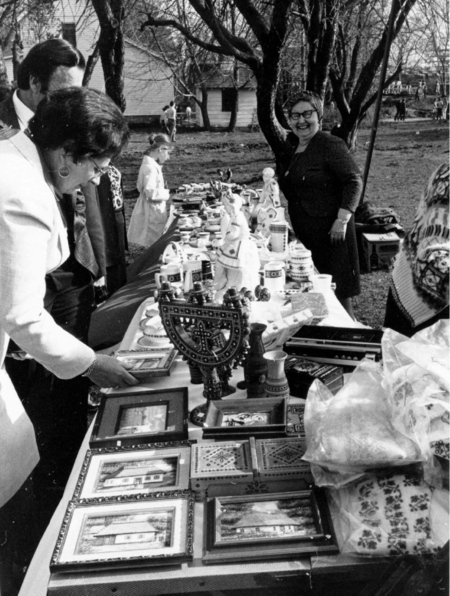
Vendor on the grounds of St. Andrew Memorial Church during ‘Provody’
For nearly 70 years, large numbers of Ukrainian Americans from the Mid-Atlantic region and beyond have been celebrating the memory of their ancestors by gathering in and around St. Andrew Cemetery on the weekend after Orthodox Easter (St. Thomas Sunday) for “Provody”, a communal visitation of graves and commemoration of deceased family and friends — something akin to a Ukrainian Día de Muertos. This tradition was interrupted only in 2020 due to the COVID pandemic.
View digitized film footage: St. Thomas Sunday at St. Andrew Memorial Church, 1975
View digitized film footage: St. Thomas Sunday at St. Andrew Memorial Church. May 3, 1981