
When Ruthenians first arrived in the Millville (Vineland-Bridgeton) area in 1910, it was rural and agricultural. The Vineland area became well known for grape-growing in the late 19th and early 20th centuries through the efforts of Charles K. Landis, a major landowner. He advertised to Italians to encourage them to purchase land for grape-growing. The sandy soil was also a major draw for the glass-making industry, with Wheaton Industries being a major manufacturer of glassware and ceramics in Millville. Poultry farming was also a major contributor to the local economy.Spahr, Rob. “Vineland celebrates its 150th anniversary with parade, fireworks and cake”, The Press of Atlantic City, August 8, 2011.
Newcomers from Galicia
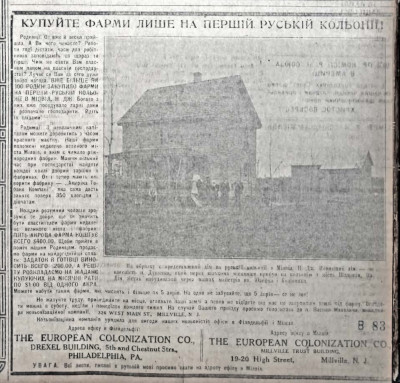
‘European Colonization Company’ advertisement for ‘the first Ruthenian colony’ in Millville, NJ (Svoboda, 1914-04-16)
Ukrainians came from the counties of Bibrka, Rohatyn, Borshchiv, Skalat, Syanik and Kolomyia in Galicia.Jubilee Book of the Ukrainian National Association in Commemoration of the Fortieth Anniversary of Its Existence. Svoboda Press, Jersey City, N.J., 1936. p. 607. In 1912, a Ukrainian real estate agent named Wasyl Metolych started to advertise land for sale near Millville in the newspaper Svoboda. This enticed about 200 families to build homes, farm buildings, two churches, and schools there. Even Ukrainians who had initially settled in North Dakota sold their farms and moved to Millville. However, the sandy nature of the local soil made it difficult to produce crops early on and many became disenchanted, suggesting they had become victims of false advertising in Svoboda. Sixteen men held a meeting at the home of N. Hevchuk on April 5, 1914 and adopted a complaint resolution which they later printed in the Narodna Volya newspaper (published in Scranton, Pa.).Halich, Wasil. Ukrainians in the United States. Chicago: University of Chicago Press, 1937. p. 49, 58.
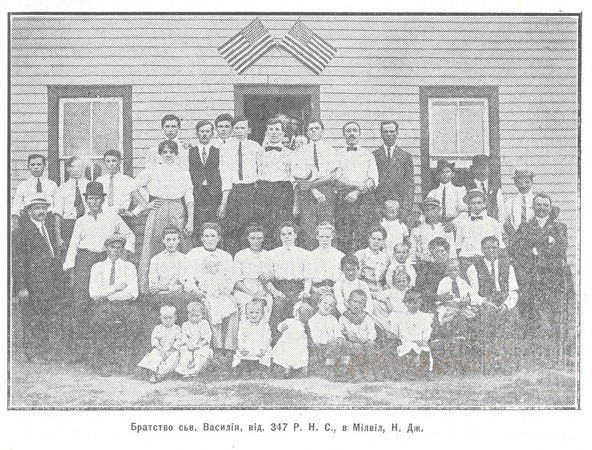
Brotherhood of St. Basil, branch 347 of the ‘Rus’kyi Narodnyi Soiuz’ (‘Little Russian National Union’) in Millville, N. J.
Time passed and many decided to keep their 10-acre farms, successfully cultivating crops for truck farming. New Ukrainian immigrants arrived and eventually there were 211 people who indicated “Ukrainian” as their primary language in the 1930 Federal Census. In addition to farming, some Ukrainian immigrants worked in glassmaking and at a cotton factory.
Two churches were built: Sts Peter and Paul Ukrainian Orthodox (1917) and St. Nicholas Ukrainian Catholic Church (first built in 1918, replaced with a new building in 1939). There were a few Ukrainian business enterprises in the area, such as a grocery and meat market, a transportation business, and a bread distributor.
The long journey of Theodore Dupnock
Theodore Dupnock (born 1866) was a long-time resident of the Millville community. He served in the Austro-Hungarian army before emigrating to the U.S from Polany in the Dukla area of Galicia. After arriving at Ellis Island in 1887, Mr. Dupnock went to Shamokin, Pa., where he became a miner for the Susquehanna Coal Company. He was a founder of the local Transfiguration Ukrainian Catholic Church there. By 1912, at age 46, he began to develop black lung disease and decided to change where he lived and worked.
The European Colonization Company located at 19-20 North Hight St. (headquartered in Philadelphia, Pa.) began a campaign to attract miners from Pennsylvania Coal Country to Millville. Mr. Dupnock bought 33 acres at a cost of $250 an acre along Carmel Rd. in 1912. He found work in the Whitall Tatum Company, one of the first glass factories in the U.S. In 1918 he donated a piece of property from his farm for the building of St. Nicholas Ukrainian Catholic Church.The Millville Daily, Millville, N.J. July 6, 1965, p. 2.
Theodore and his wife Anna would have a family of twelve children. Their son John, said that his mother (who came from a Ukrainian neighborhood in Elizabeth, N.J.) had a very demanding life on the farm making butter for local merchants and selling eggs and cheese. Her income from this activity was essential to keep the family going. John was born during the Great Depression and he said many Ukrainian children in the area had to go to work to help support their families at the time.The Millville Daily, Millville, N.J. November 10, 1982. p.1 and p. 10 Theodore Dupnock passed away in 1965, leaving a legacy of hard work and a great appreciation of Ukrainian culture to his children and grandchildren.