
The city of Passaic and the surrounding communities were a magnet for immigrants in the early part of the 20th century. By 1910, more than 50% of the city’s population of 54,773 inhabitants was foreign-born and this was the largest proportion of any U.S. city at the time.Ebner, Michael H. “Passaic, New Jersey, 1855-1912 : City-building in Post-Civil War America”. Doctoral dissertation, Corcoran Department of History, University of Virginia, 1974.
The production of textiles and other types of manufacturing provided a constant source of jobs, including companies like the Botany Worsted Wool Mills, the Okonite Cable Company, the Manhattan Rubber plant and others.History of Ukrainians in Perth Amboy. Editor, Alexander Lushnycky, PhD. 1984. pp. 79 Nearby Clifton was an agricultural hub which offered additional opportunities for new immigrant employment.
The first Ruthenian immigrants and their differences
The first Ruthenian immigrants began to arrive from Transcarpathia (Zakarpattia) and Lemkivshchyna in 1885 and in 1895 a group of 80 arrived from Eastern Galicia.Jubilee Book of the Ukrainian National Association in Commemoration of the Fortieth Anniversary of Its Existence. Svoboda Press, Jersey City, N.J., 1936. p. 617. Hungarians, Slovaks, Poles and other Eastern Europeans also came and established their own communities.
As had happened in other places where Ruthenians settled in the U.S., religious conflicts developed because of differences that existed in the Old Country. Zakarpattia was under the control of Hungary in the Austro-Hungarian Empire and there was a strong Hungarian influence over all aspects of life there including religion. There was a segment of the Lemko population who, although they were Greek Catholic, over time developed an orientation towards Russia and Russian Orthodoxy. The Ruthenians from Eastern Galicia (Halychany) became strongly pro-Ukrainian as this new identity developed in the early 20th century.
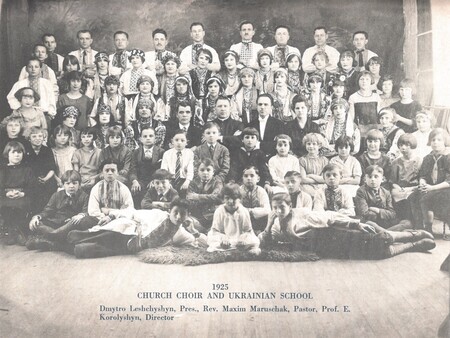
Church choir and Ukrainian school, Holy Ascension Ukrainian Orthodox parish (Passaic)
By 1903, there were three churches that Ruthenians attended: St. Michael’s Greek Rite Catholic Church (the parish began in the 1890’s and the church constructed from 1902-1905); Sts. Peter and Paul Orthodox Catholic Church (1902); and, St. Stephen’s Catholic Church (a Hungarian parish, 1903). With the selection of Rev. Soter Ortynsky as the first Ukrainian Greek Catholic bishop in the U.S. in 1907, a movement began among those Galician-Ruthenians who were pro-Ukrainian to establish their own parish. And so St. Nicholas Ukrainian Catholic Church was established in 1910. Michael Tabachuk (who arrived from Galicia in 1907) was one of the founders of the church.Jubilee Book of St. Nicholas Ukrainian Catholic Church, Passaic, N.J. 2010. pps. 80-81. One of the first full-time Ukrainian day schools in New Jersey was established in the parish in 1922. A Ukrainian Orthodox church, Holy Ascension Ukrainian Orthodox Church, was founded on Hope Avenue in Passaic in 1925. The church later moved to Clifton in the late 1960’s.
Ukrainians and the “Red Scare” of 1920
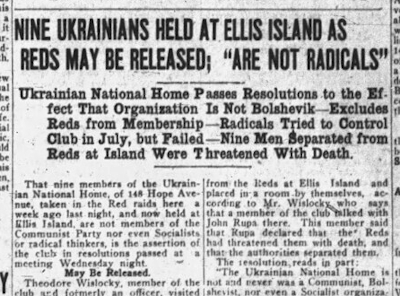
Passaic Daily News, January 10, 1920.
While the army of the Ukrainian People’s Republic was fighting to secure an independent, non-Communist Ukraine, the Passaic Ukrainian community was swept up in the national Red Scare of 1917-1920. On January 3, 1920 the Passaic Daily News reported that 16 men from the Ukrainian Socialist Club on Third St. and 8 from the Ukrainian National Home on Hope Avenue were arrested with “Communist literature”. They were part of a national round-up of 4,500 alleged members of the Communist and Communist Labor parties. Those arrested in Passaic were sent to Ellis Island for detainment and eventual deportation. The eight men arrested at the Ukrainian National Home were exonerated in late February and released.Passaic Daily News. Passaic, N.J. “64 Reds are Caught Here”, January 3, 1920, p. 1. The Paterson Morning Call. Paterson, N.J. 1920. “Release Eight Passaic Men”, February 27, 1920, p. 7. No information was published about the detainees from the Ukrainian Socialist Club.
1921 “Tag Day” and other activities
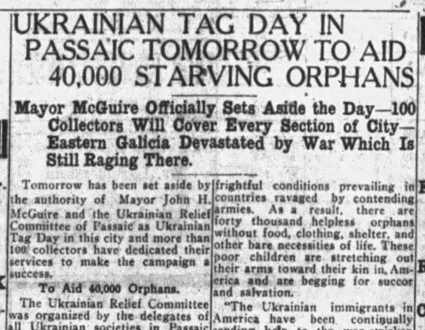
Passaic Daily News (Passaic, New Jersey), 1921-04-15
Passaic Mayor John McGuire and the Ukrainian Relief Committee of Passaic held a Ukrainian “Tag Day” on April 16, 1921 to raise funds for the children of war-torn Eastern Galicia. Rev. Leo Lewicky, pastor of St. Nicholas Ukrainian Catholic Church, participated in this effort.
Local Ukrainians showed their American patriotism by forming a League of American Citizens of Ukrainian Extraction in July 1922 in the auditorium of the new Ukrainian American school established by St. Nicholas Church. The Very Rev. Lewicky spoke at the event attended by 50 parishioners.
Several hundred people attended a mass meeting on March 23, 1923 at St. Nicholas Church hall where the Very Rev. Leo Lewicky spoke about the decision of the conference of ambassadors which granted East Galicia to Poland on March 14, 1923. After the meeting a letter was sent to President Harding and Secretary of State Hughes to protest the decision.Passaic Daily News. “Ukrainians Here Send Protest to President Harding”, March 26, 1923, p. 1.
Throughout the 1920’s and 1930’s the local press continued to report regularly on the many social, cultural and political activities of the Passaic area Ukrainian community. By 1936, there were 2,000 Ukrainians around Passaic, Clifton, Garfield, Lodi, Wallington, Rutherford, Athenia, Singac, Little Falls, and Carlstadt. The community was very active at this time, with 7 Ukrainian aid societies and 8 Brotherhoods, Sisterhoods, youth organizations, and choirs.Jubilee Book of the Ukrainian National Association in Commemoration of the Fortieth Anniversary of Its Existence. Svoboda Press, Jersey City, N.J., 1936. p. 617.
The Ukrainian National Home of Passaic
The Ukrainian National Home of Passaic dates back to 1912, when meetings of community organizations began to be held at a building known as the “Ukrainska Besida” on Fourth Street. Soon after, the building at 148 Hope Avenue was purchased and the Center was chartered in 1917. By the 1920s, that building in turn had been outgrown, and two buildings at 237 Hope Avenue were purchased in 1923. With the new space, they began teaching Ukrainian, established a library (holding 938 books in 1931), and presented amateur theatrical productions and operettas. In 1930, the Vasile Avramenko brought a branch of his dance school to Passaic. After the war, the refugee influx brought the same changes as in other cities: Ukrainian scouting organizations, a choir, and the establishment of a Selfreliance Credit Union branch.Jubilee Book. Ukrainian National Home, Passiac, N.J., 1985 The National Home, now known as the Ukrainian Center, continues to be active today at 240 Hope Avenue.