
As the Ukrainian population of northern and central New Jersey expanded and looked for more suburban and rural places to raise a family, a new Ukrainian real estate development was formed in the New Market section of Piscataway in 1927. New Market is an unincorporated community in Middlesex County near South Plainfield. In colonial times, New Market was a stop on the stagecoach route (Old York Road) from Philadelphia to New York City. It remained mostly farmland until the 1960s.
A new Ukrainian real estate development
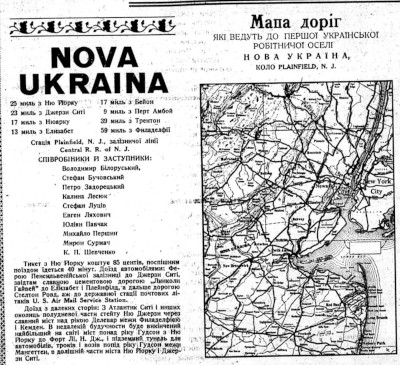
Advertisement for property in the Nova Ukraina real estate development
In March of 1927, a large advertisement appeared in the Svoboda Newspaper. The Globe Service Company located on E. 7th St. in the Ukrainian section of the Lower East Side of Manhattan described a new real estate “settlement for Ukrainians who work in factories”. It would be called “Nova Ukraina” (“New Ukraine”). It was located on Stelton Road north of the Hadley Field airport (known for being the site of some of the first U.S. Postal Service airmail flights). The ad went on to describe how bad it was to live in “the big city” and the advantages of fresh air and sunlight. There was also a patriotic appeal, suggesting it would be easier for Ukrainians to maintain their traditions and culture together in their own neighborhood. The street names would be registered to honor famous Ukrainians, such as the writers Taras Shevchenko and Ivan Franko, the composer Mykola Lysenko, the medieval Kyivan ruler St. Olga, and other Ukrainian-themed names. Showing of the property would begin in April 1927.
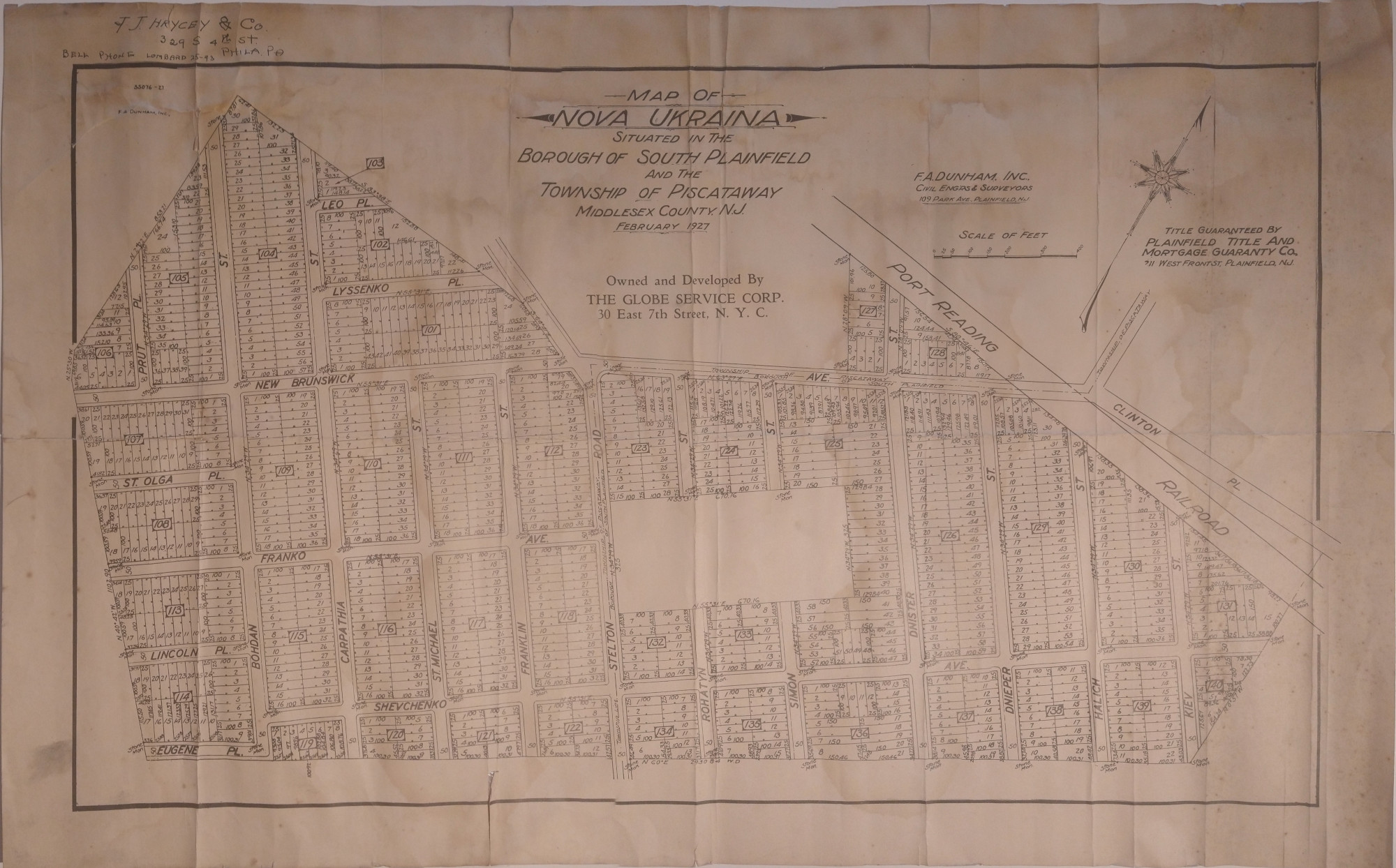
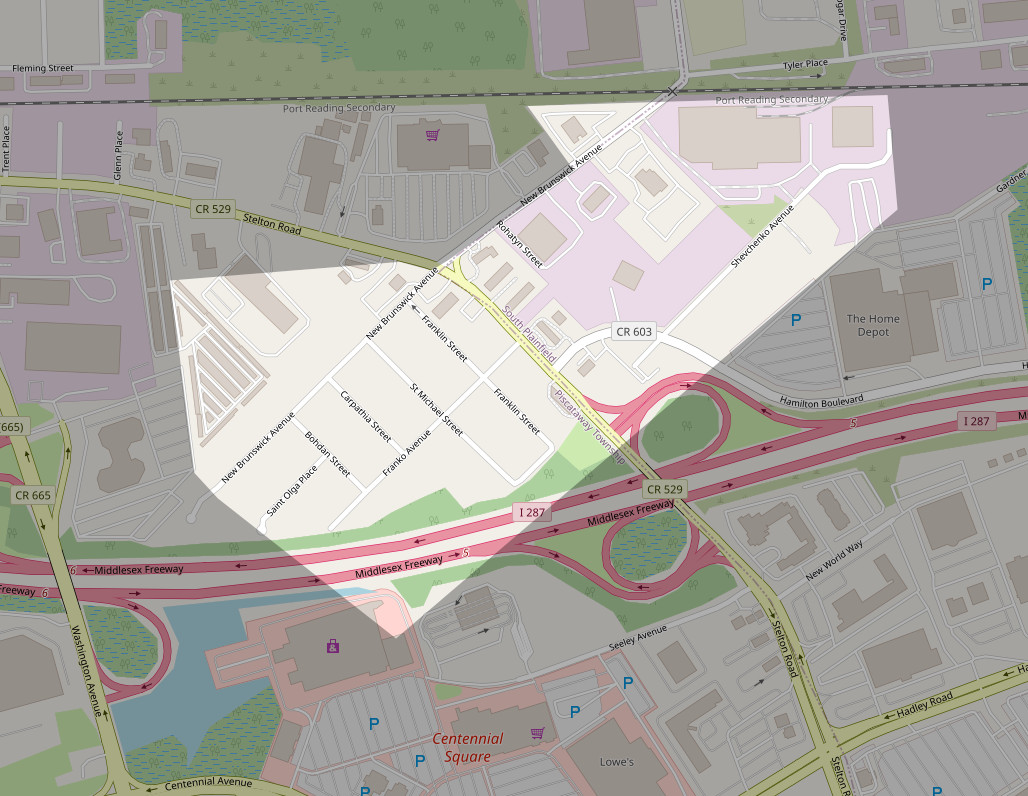
As a period map made for the Globe Service Company by the local surveying and engineering firm F. A. Dunham shows, the project was extremely ambitious. It would have included hundreds of residential parcels on either side of Stelton Road, extending to the north to the Port Reading Secondary railroad. The extent of the development can be seen by overlaying the outline of the property purchased by the Globe Service Company onto the current street map as of 2024.
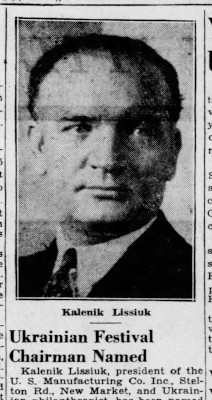
Photograph of Kalenyk Lysiuk published in the Courier-News (Bridgewater, New Jersey), 1946-03-06
“Collaborators and representatives” for this development included Myron Surmach, the founder of the venerable Surma Book & Music Co. of New York City, and Kalenyk Lysiuk (born Hryhorii Lepikash), a Ukrainian entrepreneur who by 1929 was the director of the enterprise. Lysiuk had quite a colorful personal history. He was born in the Russian Empire part of Ukraine in 1889. As a young man, he was an active Socialist Revolutionary, spent time in Siberia after being arrested, and fought in the Army of the Ukrainian People’s Republic in Ukraine’s war of independence (1917-1921) and was one of the organizers of the Free Cossack movement. He eventually came to the U.S. and started a stamp and sundries store in New York City in 1923.
After taking over the directorship of Nova Ukraina, Lysiuk moved there in 1931. His home was on the corner of Stelton Road and New Brunswick Avenue, an intersection that is now the site of a gas station and retail establishments. That intersection also had a low brick wall emblazoned with the words “Nova Ukraina”. That sign is long gone: it was demolished after being struck by a motor vehicle in the 1950s.Michael Serheev oral history interview. 2024. Ukrainian History and Education Center Archives; Valentina Syzonenko oral history interview. 2025. Ukrainian History and Education Center Archives.
Efforts were made to promote the community, including the staging of summer “happenings” to attract visitors. For the 4th of July weekend in 1927, the Boyan Choir of Newark performed, as noted on a flyer that has survived in one of the Trembita Choir scrapbooks at the Shevchenko Scientific Society Archives:Collection on the Newark, NJ Ukrainian Community. Trembita Choir (Newark, NJ) scrapbooks, volume 5. Shevchenko Scientific Society Archives Digital Collections. Image number 26.
ПРОГУЛЬКА ХОРУ ТОВАРИСТВА “БОЯН” З НЮАРКУ
НА НОВУ УКРАЇНУ, КОЛО HEADLEY [sic] FIELD.
Відбудеться в неділю, дня 3. липня, 1927. Збірка о годині 2-ій пополудни перед Українсько-Католицькою церквою при Court Street, Newark, N.J., а з відси виїзд омнібусами.
На Новій Україні відбудеться концерт хору і ріжнородні забави.
Запрошується до участи всіх, хто інтересується українською оселею Нова Україна.
Учасники з околиць їдуть через Newark до Elizabeth на станцію Central R. R. of New Jersey до поїзду на годину 12.46, літний час.
Висідати на станції Dunnelen [sic] де будуть впорядчики Нової України.
КОМІТЕТ.
P. S. Дня 4-го липня Український Павільон на Новій Україні буде отворений цілий день.
(translation)
OUTING OF THE CHOIR OF THE BOYAN SOCIETY FROM NEWARK
TO NOVA UKRAINA, NEAR HEADLEY [sic] FIELD.
To take place on Sunday, July 3, 1927. Meeting at 2 p.m. in front of the Ukrainian Catholic Church on Court Street, Newark, N.J., and departure from there by omnibus.
A concert by the choir and various entertainments will take place at Nova Ukraina.
All those interested in the Ukrainian settlement of Nova Ukraina are invited to participate.
Participants from the surrounding areas can travel through Newark to Elizabeth to the Central R. R. of New Jersey station for the 12:46 train, daylight saving time.
Get off at Dunnelen [sic] station, where Nova Ukraina organizers will be waiting.
COMMITTEE.
P.S. On July 4, the Ukrainian Pavilion at Nova Ukraina will be open all day.
Slow growth of the community
Despite these efforts to promote the community, Nova Ukraina grew very slowly, to which the Great Depression very likely contributed. A 1936 local newspaper article said plans were in place to build 50 “moderately priced” homes at about $2,450 each. Advantages of living there included a backyard chicken coop for raising poultry and a truck that brought coal directly from the anthracite region of Pennsylvania. Overall, there were 120 acres in the tract, including woodlands. Stephan Dembitsky, manager of the Metropolitan Life Insurance Company in Perth Amboy, had a house under construction there in 1936.The Sunday Times. New Brunswick, N.J. March 8, 1936, p. 24. Even as late as the 1950s, the area in pink in the 2024 map above between Stelton Road and the railroad tracks was still mostly wetlands.Valentina Syzonenko oral history interview. 2025. Ukrainian History and Education Center.
By 1942, Nova Ukraina had only a dozen Ukrainian, Polish and Russian families.The Sunday Times. New Brunswick, N.J., August 2, 1942, p. 2. However, the Piscataway area had at least 48 people who considered their first language as Ukrainian, according to the 1930 Federal Census, and nearby South Plainfield had 151 families, with 20 from Dnipro Oblast in Eastern Ukraine and the rest from Western Ukraine. In the 1950s, Kalenyk Lysiuk would leave Nova Ukraina for Ontario, California, where he would establish a Ukrainian museum (which later merged with the Ukrainian National Museum in Chicago) and a philanthropy called The Ukrainian-American Foundation. He continued to play an active role in the Ukrainian American community and politics until his death in 1980.
A landing place for displaced persons
The very sparsely settled Nova Ukraina provided a place to live for recently-resettled post-WWII refugees in the early 1950s. As part of the “Ukrainains in New Jersey” project, we have recorded oral histories from two individuals still alive in 2025 who grew up in Nova Ukraina and remember Kalenyk Lysiuk. While they did not remain in the area, this neighborhood did provide them and their families with a chance to find their bearings in a new land in a quiet, mostly rural area among fellow Ukrainians and other Slavs.Michael Serheev oral history interview. 2024. Ukrainian History and Education Center Archives; Valentina Syzonenko oral history interview. 2025. Ukrainian History and Education Center.
Present-day echos of Nova Ukraina
There are likely no Ukrainians living today in the former Nova Ukraina neighborhood of Piscataway and South Plainfield. What had been a housing development surrounded by open countryside is now a tiny residential island in the congested retail and commercial area near Exit 5 of Interstate 287. Nonetheless, some of the original street names remain, including Shevchenko Ave., St. Olga Pl., Bohdan St., Carpathia St, Franko Ave., and St. Michael St. There is even a playground that shows up on Google Maps as “Nova Ukraine Park”. The outline of the Nova Ukraina development even explains some of the otherwise inexplicable shapes of the current property lines in the area.
To indulge in utterly counterfactual speculation, it is amusing to imagine how the complexion of this area of Middlesex County would have changed if this project had succeeded. An area now dominated by commerce, light industry, and heavy traffic might have been a large residential neighborhood that would have even forced an alternative route for Interstate 287. Alas, that did not happen.