
Hillside in the 1920s would still have been a relatively bucolic suburb of Newark, having only been incorporated as a township in 1913. There were Ukrainian Americans living there, but they did not seem to leave a paper trail in the English-language press and there were no Ukrainian parishes founded there prior to World War II. However, there is one major primary source documenting this community: a book of handwritten minutes from 1922 to 1925 of an organization that called itself the “Ukrainian Educational Society ‘Mutual Aid’” which is in the archives of the Ukrainian History and Education Center.
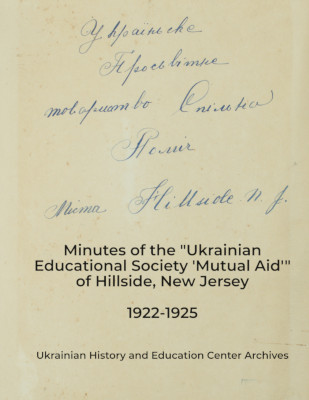
Meeting minutes of the Ukrainian Educational Society ‘Mutual Aid’ in Hillside, New Jersey
These minutes provide an interesting, albeit schematic and at times cryptic, view of the internal workings of a Ukrainian American organization in the 1920s. The society in question, unlike the massive Ukrainian National Association, was hyper-local to the Hillside area. However, its ambitions were large: within months of their formation they had purchased property with the goal of building a school and community center. We don’t know the exact address of the property, but the minutes of their February 18, 1923 meeting state that they were looking at lots “на Hardford [sic] ave коло Boloy [sic] st.”, presumably meaning “on Harvard Ave. near Bloy St.” There is nothing in the minutes about actual construction of any building. However, later entries do talk about a school for children and social and amateur theatrical events for adults.
Curiously, the society’s members refer to each other in the minutes as “tovarysh”, which can be translated as “friend”, “fellow”, or “comrade” and (as is well-known) was the preferred form of address among Communists. However, it is extremely unlikely that’s what they were, as the very first activity they undertook after their organizational meeting on New Years Eve (December 31, 1922) was to go Christmas caroling. Caroling was a very common form of fund raising for Ukrainian American parishes and organizations for much of the 20th century, but it’s probably not something that any self-respecting Marxist would be caught doing. It’s more likely that “tovarysh” came from the fact that the organization was a “society” or “fellowship” (“tovarystvo”, which comes from the same root as “tovarysh” and could be literally translated as “group of friends”). In fact, they apparently had a nontrivial discussion in that very first meeting about whether their organization should be a “tovarystvo” or a “kruzhok” (“circle”), finally settling on the former. It may have simply been natural for them to refer to a fellow member of the “tovarystvo” as a “tovarysh”. It is possible that they were socialists of some form, though the minutes do not contain anything that would shed light on their political leanings.
They were, however, very adamant about not being connected to or associated with any religious organization. When a delegation “of church representatives from Newark” (likely from St. John the Baptist parish) came to their meeting on July 22, 1923 to propose an educational collaboration, they were sent away with the message that “наше товариство і наш статут нимає і ниможе мати нїчого спільного з церквами і жадної роботи разом ниможим робити” (“our society and our bylaws do not and cannot have anything connected with churches and we cannot do any kind of work together”). It’s also intriguing that a proposal was raised at one of their early meetings (Feb. 4, 1923) to allow women to join as members, but that discussion was tabled “until the appropriate time”, which apparently never came.
Despite their initial momentum, by 1924 they seemed to be running out of steam. Already in December 1923, their president was exhorting the membership to come to meetings more frequently and to put more effort into the organization. By late 1924, they were running into serious financial difficulties and were having problems affording to heat the school and pay the teacher. It seems that they did not survive beyond 1925. Hillside would go on to have other Ukrainian American organizations, and a Greek Catholic parish would be founded there in 1957. It still exists and is located, interestingly, on the corner of Liberty Ave. and Bloy St., about five blocks away from the property purchased by the “Ukrainian Educational Society ‘Mutual Aid’” in 1923.