
Newark is the largest city in New Jersey and was founded in 1666. The city thrived during the Industrial Revolution and became a manufacturing hub through the late 19th and early 20th centuries. Various waves of immigrants provided the unskilled and skilled labor to power these industries. The Irish arrived in the 1820’s to build the Morris Canal and Germans came as refugees from the failed revolution of 1848. They would become a third of the city’s population by 1865. African Americans migrated from the South in the late 1800s and especially during the World War I factory boom in Newark. Almost 22,000 Blacks arrived between 1920 and 1930.“History of Newark: A Walk Through Newark with David Hartman and Historian Barry Lewis” Between 1880 and 1920 Newark’s Italian-born population grew from four hundred to twenty-seven thousand. Eastern Europeans began to settle in increasing numbers in Newark during the early 1900s, initially in what is now known as the Ironbound section.
By 1899, 145 Ukrainians had settled in Newark. Newark had numerous factories including in leather and textile goods and this offered them a regular source of employment for the unskilled. Most of them came from such areas of Western Ukraine as Lisko, Ternopil, Zbarazh, Rohatyn, Berezhany, Pidhaitsi, and Staryi Sambir.
Religious Diversity Among the Ruthenians
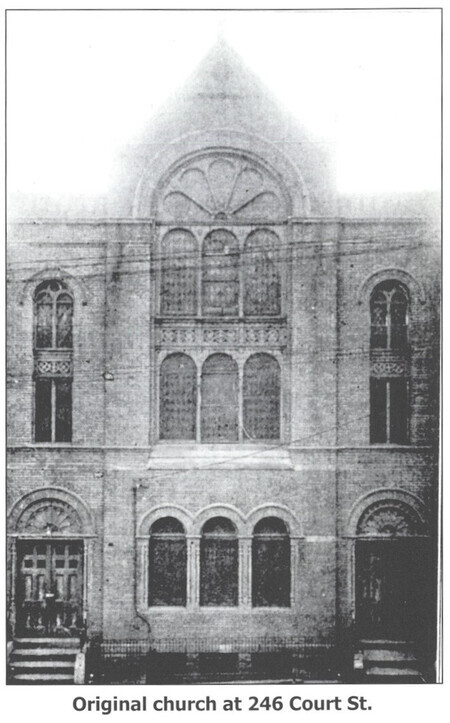
Original church building of St. John the Baptist Ukrainian Catholic parish on Court Street, Newark
Early on, Ukrainians attended church services in nearby Jersey City and Elizabeth. In 1907, the Greek Catholic Church of St. John the Baptist was founded in a building at 246 Court Street in Newark purchased from the First Evangelical Association for $17,500. This was in what is now the Central Ward. In 1911, the Very Rev. Peter Poniatishin became pastor of the church and in 1915 the Diocesan Administrator for the Ruthenian Greek-Catholic Church in the United States. Thus Newark became the official seat of the Ukrainian Catholic Church in the United States. Rev. Poniatishin undertook a key leadership role in the effort to convince the U.S. Government to recognize the nascent Ukrainian National Republic at the end of World War I.Buryk, Michael. “The United States and the Issue of Ukrainian Statehood, January 1918-December 1920”. pp. 394-399. In Dushnyck , Walter, and Chirovsky, Nicholas L. Fr., editors. The Ukrainian Heritage in America. New York: Ukrainian Congress Committee of America, 1991. He was also an important public figure in the local Newark community as well.
, which has numerous other images related to this parish ([archived site](https://web.archive.org/web/20240521154448/http://newarkreligion.com/photos/index.php?cat=80))](https://newarkreligion.com/photos/albums/userpics/10001/presruth01.jpg)
First Ruthenian Presbyterian/First Ukrainian Presbyterian Church of St. Peter and St. Paul, Exterior, 1911. Photograph from https://newarkreligion.com/photos/index.php?cat=80, which has numerous other images related to this parish (archived site)
Newark was the site of the establishment of the first Protestant Ruthenian (later Ukrainian) church, the First Ruthenian Presbyterian Church of St. Peter and St. Paul. It was organized in June 1909 at 49/51 Beacon St, Newark, NJ. The pastor at the time was Rev. Volodymyr Pyndykowsky. Because of a 1907 dispute over the control of the St. John the Baptist Church property on Court Street and parish finances, a group of about 100 parishioners with the Rev. John Bodrug petitioned the Newark Presbytery to become a Presbyterian parish. They were formally accepted in 1909.The Newark Sunday Call. Newark, N.J. “Greek Church Case in Chancery”, July 10, 1908, p.2, “Mass is Now Celebrated in a Newark Presbyterian Church”, February 20, 1910, p.17, and “Mass and Prayers to Virgin in a Presbyterian Church”, March 10, 1912, Magazine Section, Part III, p.1. Kuropas, The Ukrainian Americans, pp. 70-71.
Rev. Vasyl Kuziw, the pastor of the Ukrainian Presbyterian parish from 1912-1917, was very active in both Ruthenian community and local public life and in 1913 was instrumental in initiating a program of Ukrainian studies at Bloomfield College which continued into the 1930’s. Bloomfield was a nearby suburb to Newark. Rev. Kuziw had arrived in the U.S. with his parents in 1904 coming from the village of Denysiv in Ternopil Oblast, Ukraine.Bykovskyi, Lev. Vasyl Kuziv. His Life and Activities (in Ukrainian). Detroit, 1966. Ukrainian Evangelical Association in North America. pp. 8-16. Throughout his life, he traveled extensively in Ukraine and was responsible for several humanitarian efforts to aid the population there. Kuropas, Myron B. The Ukrainian Americans: Roots and Aspirations 1884-1954. Toronto, Canada: University of Toronto Press, 1991. pp. 322-323. He also supported the establishment of a Ukrainian book section at the Newark Public Library, which was under the leadership of John Cotton Dana who was very supportive of the effort to establish a large foreign language book collection. Mr. Cotton Dana published a Ukrainian language advertisement in the local press in February 1914 to encourage the use of newly purchased Ukrainian books at the library.
In addition to Ukrainian Catholic and Presbyterian parishes, Newark also saw the establishment of a Ukrainian Orthodox Parish in 1918, the Ukrainian Orthodox Church of Holy Ascension (which moved to nearby Maplewood in 1974). In 1929, St. George Byzantine Catholic Church was organized at 26 Houston Street (and later stood at 208-214 Warwick St.). It is part of the Byzantine Catholic Eparchy of Passaic, the Byzantine-Ruthenian Catholic Church, which serves the community of the Carpatho-Rusyns in the U.S.
Early Ukrainian Community and Public Life in Newark
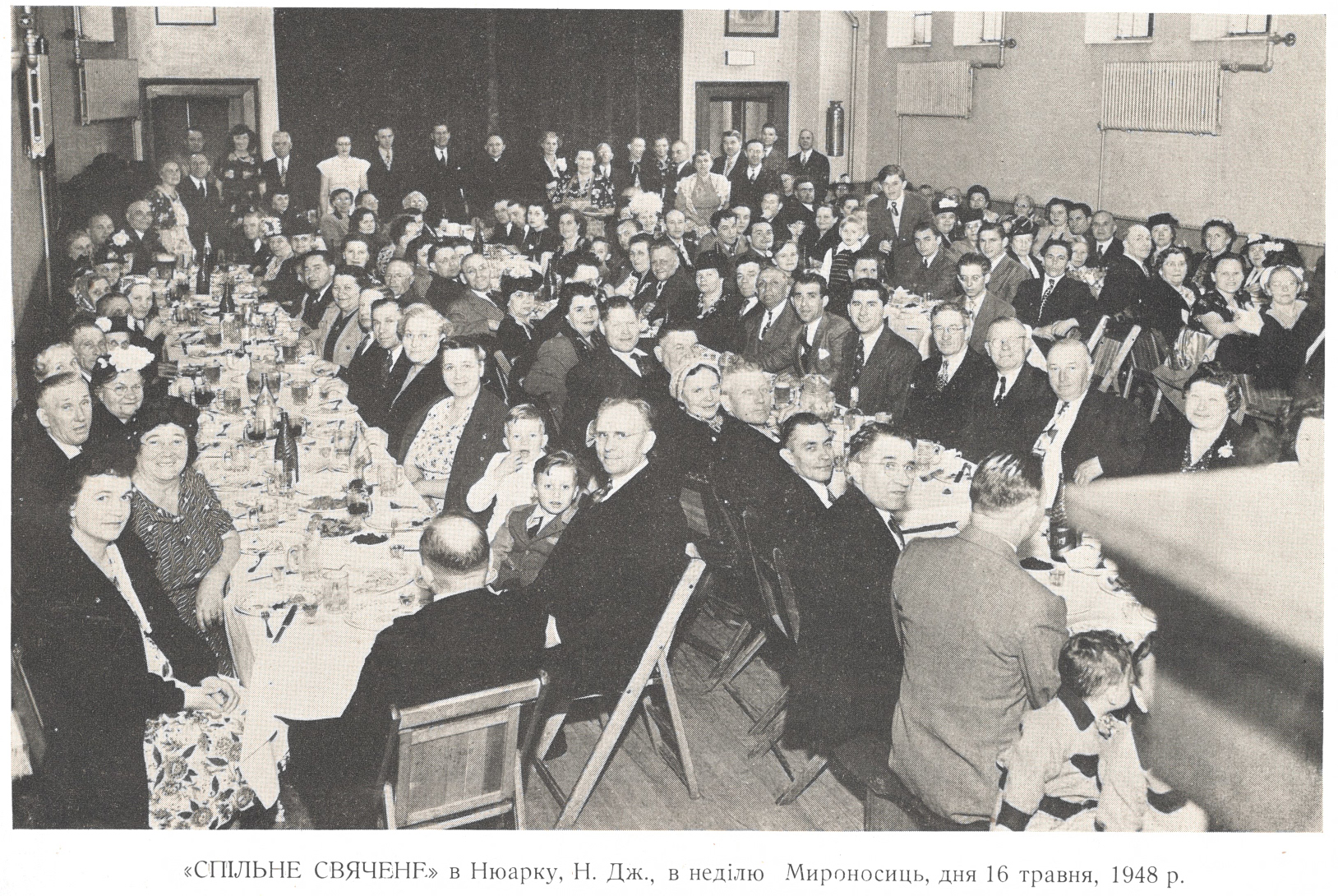
“By the twentieth century, two-thirds of Newark’s population was foreign-born; census takers could identify more than 30 city neighborhoods with a predominant ethnic or racial group.”Malanga, Steve. “Philip Roth’s Newark”, City Journal. Spring, 2017. (https://www.city-journal.org/article/philip-roths-newark) And, Ukrainians were an integral part of this immigrant stew. By 1936 according to the Ukrainian National Association, the number of Ukrainians in Newark would grow to almost 7,000.Jubilee Book of the Ukrainian National Association in Commemoration of the Fortieth Anniversary of Its Existence. Svoboda Press, Jersey City, N.J., 1936. p. 614. Many lived in the old Third and Thirteenth Wards of the city (now part of the Central Ward).
One key leader of cultural and educational life in the city was Theodosius Kaskiw, a teacher and choir director who would organize the Boyan male choir in 1909 (reorganized as a mixed choir in 1911), teach the Ukrainian language, and direct amateur theatrical productions. He would continue to play a major role in the Ukrainian life of Newark, being the de facto leader of the community’s “old immigration” through the 1960s.Golden Almananc: The Fiftieth Anniversary of the Ukrainian National Home and History of the Ukrainian Community of Newark & Vicinity, 1977. pp. 7, 12.
Ukrainians (Ruthenians) developed a thriving community in the first decades of the 20th century in Newark. Some of their public events were covered in the local press. One stood out. On September 23, 1916 1,500 Ukrainians gathered in native dress including a division of Kozaks with the Boyan Choir singing on a float and paraded down Broad St. along with many other ethnic groups to celebrate the 250th anniversary of the founding of Newark.The Newark Sunday Call. Newark, N.J. “Picturesque Dresses Worn in Parade of Ruthenians”, September 25, 1916, p. 23. And, later that evening a concert was held at the local Metropolitan Theater dedicated to the Ukrainian writer and poet Ivan Franko. All of this was done under the auspices of St. John the Baptist Ukrainian Catholic Church.
The WPA “New Jersey Ethnological Survey”
During the later 1930’s, the Federal Works Progress Administration (WPA) conducted a survey of New Jersey ethnic groups through the New Jersey Writer’s Project. The New Jersey Ethnological Survey began its work in July 1938 under the direction of Charles W. Churchill and Vivian P. Mintz. Its focus was ethnic groups in Newark and nearby communities. A total of 14 ethnic groups were surveyed including Ukrainians. Documentation and records for this project are kept at the New Jersey State Archives in Trenton.New Jersey State Archives, Works Progress Administration (WPA), New Jersey Writers Project, New Jersey Ethnological Survey Records, 1935-1939, Box 5, Folders 13-28.
Basil Wheeler’s research and writeup about Ukrainians in Newark and nearby Irvington offers a detailed snapshot of the community primarily covering the period 1938-1939. There is a detailed list of 18 “Ukrainian leaders in Newark” which includes people like John Romanition and Stephan Shumeyko.
John Romanition (an anglicized spelling of the Ukrainian surname Romanyshyn) was a second-generation Ukrainian American who became a local attorney after graduating from the Law College of the University of Newark (which merged with Rutgers University in 1946 and was renamed the Rutgers University School of Law). Born in 1915 in Newark, Romanition would have a long career as an attorney in the Newark area, becoming assistant prosecutor of Essex County. He was also prominent in Ukrainian American affairs, serving two terms as president of the Ukrainian Youth League of North America (1937-1939). His father Paul, who arrived in the U.S. in 1909, was listed as one of the oldest Ukrainian residents of the Newark area community.
Stephan Shumeyko was another important Newark-born Ukrainian American community leader. He became the first editor of The Ukrainian Weekly when it was launched in 1933. He also organized the Ukrainian Youth League of North America and was its first president from 1933–1936. Mr. Shumeyko was also president of the Ukrainian Congress Committee of America from 1944–1949 and was an author and translator.Encyclopedia of Ukraine. University of Toronto Press, 1993. Vol. 4, p. 685.
The Newark ‘Tsentralia’
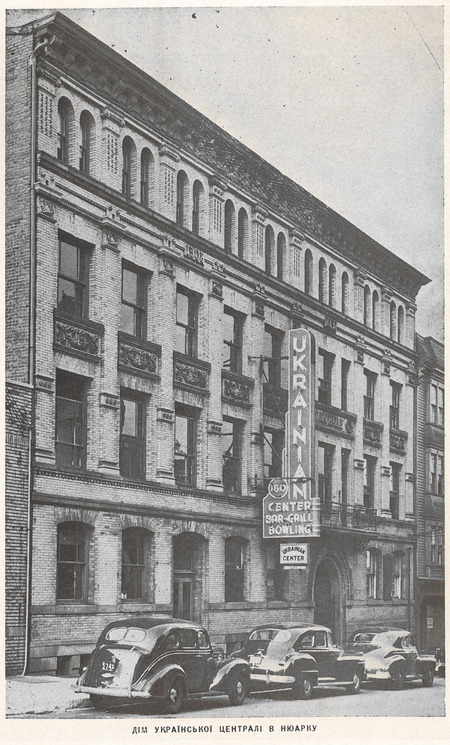
The Newark “Tsentralia”
In 1927, an effort was begun to purchase a facility that would house a Ukrainian community center (or “National Home”) in Newark. Plans were made to purchase two buildings and adjacent vacant lots on the corner of Morton and West Streets, but this deal fell through due to economic difficulties associated with the start of the Great Depression.
In 1939, the community was able to purchase the four story brick building at 180-186 William Street that had been owned by a Newark German community organization which had gone bankrupt. Based on legal advice, the purchase was made under a new corporate entity, the “Ukrainian Community Center” (or “Ukrains’ka Tsentralia”). This building would become the focus of non-church Ukrainian community life through the first half of the 1950s and would serve as the headquarters for numerous community organizations.Golden Almananc: The Fiftieth Anniversary of the Ukrainian National Home and History of the Ukrainian Community of Newark & Vicinity, 1977. pp. 8-10.
Post-World War II boom and decline
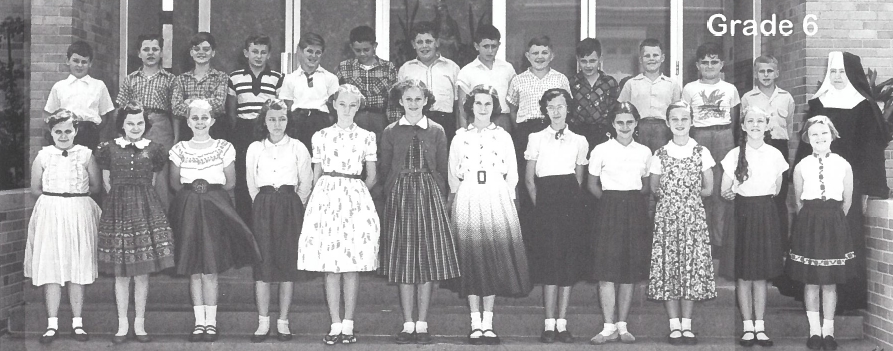
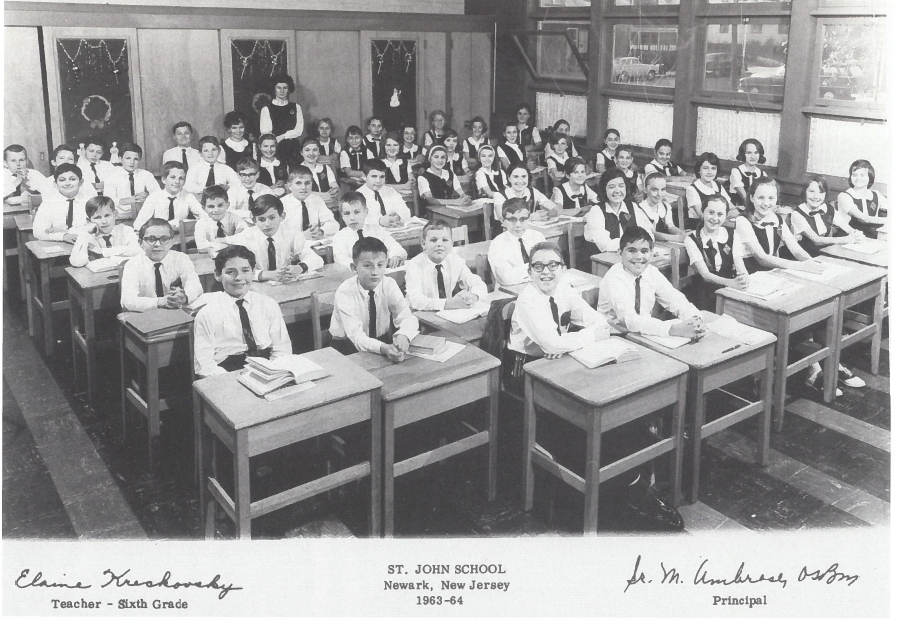
As in other places, the post-WWII Third Wave significantly changed the complexion of the Newark community. New organizations were formed, education was revitalized, and new youth organizations catered to the boom of children born during the new-found stability after years of war and displacement. This “baby boom” is easily visible in the class photos of the St. John the Baptist School:
Among the new organizations that were formed in this period was Trembita Choir, which in some respects replaced the by-then defunct Boyan Choir started by Kaskiw in the early decades of the century. The activities of this ensemble and, indirectly, the community events that they participated in are documented in a remarkable set of scrapbooks housed in the archives of the Shevchenko Scientific SocietyCollection on the Newark, NJ Ukrainian Community, Trembita Choir scrapbooks. Shevchenko Scientific Society Archives. and are available in digital form. In them, you can the astounding variety of programs and activities taking place in Newark, other parts of New Jersey, and beyond that the choir sponsored or participated in.
One interesting form of youth activity distinctive to Newark were the Hailky (spring dances) performed by the children and young adults of St. John the Baptist parish at Easter. This was essentially a self-organized activity with little or no adult involvement: each age group was taught the songs and movements by their slightly-older peers, some of whom had likely learned them in villages in Ukraine prior to the war. As such, this was effectively a living tradition transplanted from Ukraine to Newark by post-WWII refugees.Virlana Tkacz oral history interview . 2025. Ukrainian History and Education Center Archives.
By 1956, however, the “Tsentralia” was facing a financial crisis. “White flight” to the other areas of the city and to neighboring Irvington had reduced the size of the local community, and Ukrainian Americans were no longer attending events at the “Tsentralia”. In 1960, the Newark Housing Authority notified the “Tsentralia” that it was intending to purchase the building for planned highway construction and “urban renewal”. In 1964, the “Tsentralia” decided to purchase an old factory building and adjacent structures at 140-146 Prospect Avenue in Irvington as a new location for a Newark/Irvington National Home, which it refurbished and opened as a community center in 1965.Golden Almananc: The Fiftieth Anniversary of the Ukrainian National Home and History of the Ukrainian Community of Newark & Vicinity, 1977. pp. 11-12. While St. John the Baptist Ukrainian Catholic Church continues in its new home (since 1965) on Sanford Avenue, much of its vibrant cultural life has moved elsewhere in the state.