
When the first Ukrainians (Ruthenians) came to Jersey City in the 1880’s, they were part of the “New” Immigration that made its way to the Garden State from 1880 to 1920. Adventurous newcomers arrived in increasingly larger numbers from southern and eastern Europe from countries including Italy, Poland, Russia, and the Austro-Hungarian Empire. They would find well established communities of British, Germans and Scotch-Irish of the “Old Immigration” who had come to this industrial town during the period 1840-1880.Shaw, Douglas V. Immigration and Ethnicity in New Jersey History. Trenton, N.J. 1994. New Jersey Historical Commission, Department of State. pp. 17-48.
Jersey City in the 1880’s was a bustling manufacturing and port city, fueled by New Jersey’s overall dynamic economy, with an expanding industrial base and a constant demand for skilled and unskilled labor. Jersey City newcomers found work in the steel, tobacco, and pencil factories often located within walking distance of the tenements they occupied in the Paulus Hook section also known as “Gammontown”. The neighborhood lay within the shadow of the Statue of Liberty and nearby Ellis Island, which had become the gateway to America for many immigrants from Eastern Europe.
For Ukrainian immigrants, the “Sugar House” on Washington near Morris Street became a major employer. This waterfront warehouse on the corner of Essex and Washington Streets on the south side of the Morris Canal was designed in 1863 and later became part of the American Sugar Refining Company.Dowd, Kevin. Downtown Jersey City - The History Behind The Sugar House. 2010. (Archived web page captured Feb. 29, 2024) By 1907, the Refining Company employed over fifteen hundred workers and occupied four city blocks, where it refined raw sugar imported from around the world. In 1910, many of the Ukrainian immigrant men who lived in the nearby tenements on Morris Street worked there, including Semen Sawchyn (the great uncle of Michael Buryk, the primary author of this essay), who arrived in 1907.
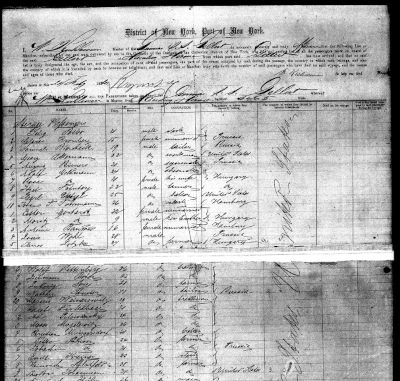
Passenger manifest showing the arrival of Paul (Pavlo) Filak
One of the first Ukrainians to emigrate to Jersey City was a Lemko from Luhiv (now Ług, Poland, province of Horlytsi/Gorlice in Galicia). Paul (Pawlo) Filak was born in 1845 and his occupation was listed in immigration records as “cartwright” (i.e., wheelmaker). Other Lemkos soon followed in his footsteps and by 1887 there were 17 Ukrainian families in Jersey City. This number grew to 150 by 1899.Lutwiniak, Theodore. “Ukrainians Active Here Since 1879”. The Jersey Journal, Jersey City, New Jersey, May 2, 1942, p. 103.
Religion played an important role in the establishment of Ukrainian community life in Jersey City. In 1884, the Rev. Ivan Wolansky (Volanskyj) arrived in Jersey City and considered establishing a Ukrainian Greek Catholic parish there. But, he had been invited by a group of Ruthenians in Shenandoah, Pa., to establish a parish there. Since they paid for his passage to the U.S., he left for Coal Country to establish St. Michael’s Church in Shenandoah as the first Greek Catholic Church in the U.S. He returned to Jersey City in 1887 and established Saints Peter and Paul Ruthenian Greek Catholic Church for the local Ukrainian community and a small, wooden chapel was built on Henry St. in the Heights.“Saints Peter and Paul Ukrainian Catholic Church: A History”. 21 unnumbered pages, pp. 1-3. In 1887-1987: Commemorative Book of Saints Peter and Paul Ukrainian Catholic Church. Jersey City, N.J., 1987. Later a large, five-domed brick church was built at the corner of Sussex and Green Streets in 1902.
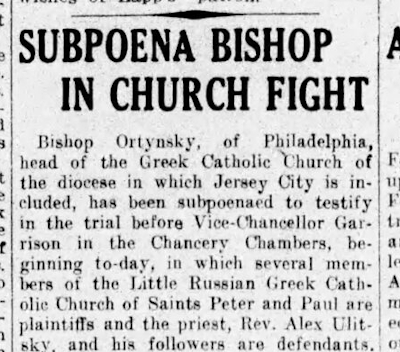
The parish continued to grow, but would eventually split. In 1907, Saints Peter and Paul Church as a parish of the North American Ecclesiastical Mission under the Holy Synod of the Orthodox Church in Russia was established on Grand Street where it stands today. In 1915, a group of Ruthenian families in the Lafayette section of Jersey City formed their own church which became known as St. Mary’s Byzantine Catholic Church. This religious conflict would play out in many Ukrainian-Ruthenian communities throughout the U.S. in the early part of the 20th century.
The Birth of Svoboda and the Ukrainian National Association
In 1889, Fr. Hryhorij (Gregory) Hrushka arrived in Jersey City to become the first permanent pastor for Saints Peter and Paul Parish. Besides putting the parish on a firm footing, he was very active in local civic and community affairs. In 1890, he established a Ukrainian cooperative store, the “Ukrainian Trade Market”, located at 102 Morris St. The grocery store was established to protect Ukrainian immigrants from unscrupulous merchants. In his apartment on nearby Warren St., Fr. Hrushka began publishing the Ukrainian newspaper “Svoboda” (freedom) on September 13, 1893 with the help of Denys Saliy, Sidor (Isidore) Ferenc, Denys Pirch and Denys Holod. This newspaper became an important channel in the Ukrainian immigrant community for the exchange of information, ideas and civic engagement. It continues its publication today.“Saints Peter and Paul Ukrainian Catholic Church: A History”, p. 3. In 1887-1987: Commemorative Book of Saints Peter and Paul Ukrainian Catholic Church. Jersey City, N.J., 1987.
On December 1, 1893, Fr. Hrushka helped form a political club headed by Pawlo Stupynsyj. This organization would lead to the establishment of the “Ruthenian (later Ukrainian) National Association” in February 1894 in Shamokin, Pa. The group was established to give a solid and effective structure to the growing Ukrainian American community.
Learn more about ‘Svoboda’ and the Ukrainian National Association
Prosperity and Roles in Civic and Cultural Life
Ukrainians continued to arrive in Jersey City in the early part of the 20th century until World War I broke out in 1914. As second generation was born and grew up in this urban Ukrainian village. The “Old” immigrants in Jersey City became acquainted with the newcomers through their many public performances announced in the Jersey Journal newspaper and other local press. As World War I dragged on, Ukrainians organized fundraisers for humanitarian aid for Ukraine. At the end of the war when it appeared that Ukraine might have an opportunity to finally secure its independence, Ukrainians in Jersey City were active in promoting this cause and lobbying the U.S. government. During the 1920’s, mass rallies were held in the city to publicize the plight of Ukrainians as the western part of the country (eastern Galicia) came under the jurisdiction of Poland.“The Jersey Journal”, Jersey City, New Jersey. Nov. 12, 1921, p.6 and Nov. 14, 1921, p. 9.
An important focal point for the community was the Ukrainian National Home. As early as 1894, Fr. Hrushka hoped to establish a center for the local community, but various conflicts slowed its establishment until September 1918. Then it was located at 1012 Newark Avenue and became a community hub for cultural and social events.“Saints Peter and Paul Ukrainian Catholic Church: A History”. p. 12. In 1887-1987: Commemorative Book of Saints Peter and Paul Ukrainian Catholic Church. Jersey City, N.J., 1987. The building at this location was sold in 1927 and a new Ukrainian National Home was in the Heights section of the city in 1932. There was a general revival of Ukrainian community life in Jersey City during the 1930’s and the new Ukrainian Home played a major role in it.
Since then, the Ukrainian National Home moved again in 1958, and the Ukrainian National Association sold the building on Grand Street and moved to an office tower on Montgomery Street from 1974 to 1997. While the population shifts that have thinned urban Ukrainian populations since the 1950s have also impacted Jersey City, this cradle of Ukrainian culture in the Garden State continues to have its National Home and a vibrant community invigorated by recent migrants.