During the last quarter of the twentieth century and into the first quarter of the twenty first, three Ukrainian academics stand out at two New Jersey universities: St. Peter’s College (now a university) and Rutgers University, Newark. All three made important contributions to the awareness and understanding of Ukrainian Americans about Ukrainian history, political science, economy, society and culture.
Prof. Konstantyn Sawczuk: Chair of the history department at St. Peter’s College
Eighteen-year-old Konstantyn Sawczuk arrived in New York with his parents in 1950 as one of many Ukrainian displaced persons from Europe after World War II.Ancestry.com, Passenger Lists of Displaced Persons, 1946-1971, Konstantin Sawczuk. He was born in Horodenka, Ukraine, in 1931. He and his parents Paul and Sofia had been residents of the Regensburg DP camp near Nuremberg, Germany. They settled in Jersey City.
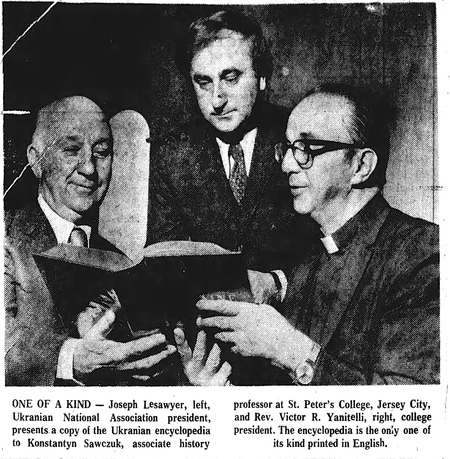
Konstantyn Sawczuk (center) with Rev. Victor Yenitelli (right) and Joseph Lesawyer (Lysohir)
Konstantyn attended local schools including St. Peter’s College from which he graduated in 1956. He later received his master’s and PhD degrees in Russian and Soviet history from Columbia University. He began teaching history at St. Peter’s College in 1964 and continued here until his unfortunate early death in 1981. His specialty was East European Studies, and he eventually became chairman of the history department. In January 1975 he published, “The Ukraine in the United Nations organization: A study in Soviet foreign policy, 1944-1950”.
One of the present authors (MB) took several of his history courses while attending St. Peter’s College from 1968-1972. Dr. Sawczuk as a very stimulating and inspirational professor who shared his extensive knowledge of Ukraine with his students including discussions about the contemporary Soviet Ukrainian dissidents (“shistdesiatnyky”). For example, he assigned as reading in one of his classes the book by Ivan Dziuba, “Internationalism or Russification?” in which the writer and social activist analyzed from a Marxist position the national and cultural policy of the Soviet Union in Ukraine at the time (1968).
Konstantyn Sawczuk was the recipient of many awards for his outstanding achievements as a professor.The Jersey Journal, “St. Peter’s profs, administrator honored”, March 27, 1973, p. 5. In October 1972, he coordinated at St. Peter’s a symposium on dissent in Eastern Europe featuring several local academics discussing the current situation in the Soviet Union, Poland and Hungary. The Ukrainian National Association and Sts. Peter and Paul Ukrainian Catholic Church sponsored a folk festival the weekend of the conference to show local Ukrainian community support for the event.The Jersey Journal, “Dissent in Eastern Europe will be topic at St. Peter’s”, October 18, 1972, p. 26.
In memory of Dr. Sawczuk’s many academic achievements, St. Peter’s University History Department holds an annual Sawczuk Conference at which students and faculty present their research to the university community.
Prof. Taras Hunczak: Ukrainian American historian, political scientist and volleyball coach
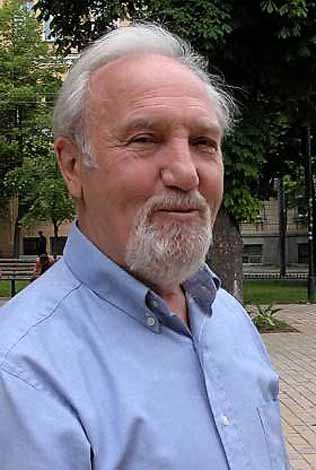
Taras Hunczak was born in the village of Stare Misto near Pidhaitsi in Ternopilska Oblast in Ukraine in 1932.Hunczak, Taras. My Memoirs: Life’s Journey through World War II and Various Historical Events of the 21st Century. Plymouth, UK: Hamilton Books, 2016, p. 1. He and his family left their village in 1944 and headed west to Germany. They lived there for a while with other Ukrainians who performed forced labor in local factories near Vilsbiburg in Bavaria near Munich until the Allied liberation. They eventually departed for the U.S. in the spring of 1949.
The Hunczak family settled in the Buffalo, New York, area. Taras attended high school there and later enrolled in Canisius College. But, by the spring of 1953 he decided to go to New York City and matriculate at Fordham University. He graduated from Fordham in 1955 with a B.A. and an M.A in 1958. His mentor was the prominent Polish historian Oskar Halecki, an expert on Eastern European history. Taras would also focus on Eastern European and Soviet studies. After graduation he studied at the University of Vienna and by May of 1960 he had earned a degree as a Doctor of East European History.Hunczak, Taras. My Memoirs: Life’s Journey through World War II and Various Historical Events of the 21st Century. Plymouth, UK: Hamilton Books, 2016, pps. 27-39.
He returned to the U.S. and got a position lecturing in Eastern European history and the history of Russia and the Soviet Union at Rutgers University (Newark) in 1960. He would later become Director of the East European and Soviet Areas Studies Program and Chair of the History Department there. Taras left New York City in the summer of 1961 and settled in Irvington, N.J. where he married his wife, Olia Karpenko.
Taras Hunczak’s more than 40-year academic career at Rutgers was marked by many important achievements. He organized at the Newark campus a Slavic festival including entertainment by Ukrainian, Polish, Byelorussian and other groups for more than a decade beginning in 1974.The Jersey Journal, “Slavic Arts Festival to be given in Newark”, March 16, 1984, p. 42. In March 1982, he was one of the coordinators of a special project, “Hromada: Ukrainian Folklife in New Jersey”. This symposium-concert-exhibition which took place at Rutgers was sponsored by Rutgers with several Ukrainian community groups and the New Jersey Historical Commission. It included an engaging publication, “Ukrainian-Americans: An Ethnic Portrait”, with photos by Donald P. Lokuta and text by David S. Cohen.The Star Ledger, Newark, N.J. “Jersey Ukrainians Will Celebrate their Heritage”, March 21, 1982, p. 78. This photo essay offered a unique visual snapshot of New Jersey Ukrainians and their traditions. Many of them lived in the northern part of the state.
Dr. Hunczak also spoke out frequently on behalf of Soviet Ukrainian political prisoners. In 1990 during the period when Glasnost reforms rippled through the Soviet Union, several speakers came to Rutgers from the Ukrainian SSR including the dissident Ivan Dziuba for a conference entitled “The Contemporary Ukraine”.The Star Ledger, Newark, N.J. “Ukrainian Intellectuals foresee long, hard road to independence”, March 16, 1990, p. 7.
Taras Hunczak was also active in efforts to aid victims of the 1986 Chernobyl nuclear accident. In 1989 together with the Ukrainian Dr. Zenon Matkiwsky, a resident of Short Hills and chief of surgery at Union Hospital in Union, N.J., they founded the Children of Chernobyl Relief Fund (CCRF). In February Mr. Hunczak and Dr. Matkiwsky with other members of CCRF travelled to Kyiv to bring back Vasilij Kavasiuk and his 6-month-old daughter Maria who was suffering from leukemia and would be treated in Union Hospital.The Star Ledger, Newark, N.J. “Jersey MD takes aid to Ukraine, brings home 2 Chernobyl victims”, February 19, 1990, p.1.
Dr. Hunczak was present in Kyiv during the December 1991 referendum that sealed Ukraine’s independence from the Soviet Union. He was on a 5-month teaching stay at the Kyiv Polytechnic Institute and The Taras Shevchenko National University of Kyiv. “It was an incredible time. The atmosphere was beyond description. … Nobody expected the vote (for independence) to be as large as it was.”The Star Ledger, Newark, N.J. “Ukrainian returns to homeland he fled to discover democracy blooming”, December 21, 1991, p. 3. Professor Hunczak would make additional trips to teach in Kyiv in 1995 and 1998 as a Fulbright Scholar.The Courier-News, Bridgewater, N.J., “People in Education”, February 26, 1995, p. B-7. The Daily Record, Morris County, N.J., “College News”, January 23, 1998, p. C7. In 2013, the National University of Kyiv-Mohyla Academy awarded him an honorary doctorate. He retired from full-time teaching in 2004 and became a Professor Emeritus at Rutgers.
Dr. Hunczak left behind an extensive list of scholarly works on modern Ukrainian history, Russia and Eastern Europe. Early on in his academic career, he became well-known for his article reappraising the controversial Symon Petliura and Jewish-Ukrainian relations for the journal of Jewish Social Studies. In addition to being an ardent Ukrainian American community activist and scholar, he played an integral leadership role in the men’s volleyball program at Rutgers which included several Ukrainian Americans on his championship team in the 1970’s. Taras Hunczak was also a loving family man. He passed away in 2024 in Chatham, N.J., at the age of 92. He was truly a vital bridge between modern Ukraine and the Ukrainian Diaspora especially in New Jersey and the New York area.
Prof. Alexander Motyl: historian, political scientist, professor, writer, poet, translator and painter
Alexander Motyl was born in 1953 in the “Ukrainian Village” of the Lower East Side of Manhattan of Ukrainian parents from the Lviv region (although his mother held U.S. citizenship). Motyl, Alexander. Bits and Pieces: Fragmentary Memoirs. Independently published, 2020. Chapter 2. who came to the U.S in the third wave of Ukrainian immigration. He attended the Jesuit-run Regis High School and later received a BA in History from Columbia University in 1975 and a Ph.D. in Political Science from the same institution in 1984. Professor Motyl has taught at Columbia University, Lehigh University, the Ukrainian Free University, Harvard University and the National University of Kyiv-Mohyla Academy. Since 1999, he has been professor of political science at Rutgers University (Newark).
He is author of eight academic books and editor or co-editor of over fifteen volumes. His focus is the Soviet Union, Ukraine, revolutions, nations, nationalism, empires and theory. In addition to his academic writing, he writes opinion pieces in such publications as Foreign Policy, 19FortyFive and The Kyiv Post, which is the oldest daily English language newspaper in Ukraine. He has been ranked by the organization Academic Influence among the top ten political scientists in the field today. Motyl is a poet, a writer of fiction and a visual artist.
In 2019, Prof. Motyl received the Omelian and Tatiana Antonovych Foundation award at the Embassy of Ukraine in Washington, D.C.The Ukrainian Weekly, “Alexander Motyl honored with Antonovych Foundation Award”, September 29, 2019, p.3. The annual award of $10,000 has been given by the Omelian and Tetiana Antonovych Foundation since 1981 for literary works written in Ukrainian and for research in Ukrainian studies. Among the recipients of this award are the Ukrainian dissident and literary critic Ivan Dziuba (1990) and the Ukrainian American historian Serhii Plokhy (2015).
The courses he has taught at Rutgers include: The Government and Politics of Russia and the Soviet Union; Nationalism, Revolution, and War; Research Methods; Politics, History, and the Arts; Great Political Speeches and the Art of Rhetoric; Seminar on the Soviet Union; and Comparative Politics. Prof. Motyl is also associated with these programs: Non-Resident Senior Fellow, The Atlantic Council, 2009-present; International Advisor, Ph.D. Program in Media Studies, National University-Kyiv Mohyla Academy, Kyiv, 2009-present; Faculty Associate and Program Director, Center for the Study of Genocide and Human Rights, Rutgers University-Newark, 2007-present; and, Member, Ukrainian Studies Advisory Board, The Harriman Institute, 1999-present.
Alexander Motyl has been and continues to be a very influential, distinguished and creative resource for Ukrainian studies and culture in the Garden State, in the New York metropolitan area and around the world.