
Ruthenians began migrating to Perth Amboy in 1884 and to Carteret in 1896. Perth Amboy was settled in 1683 by Scottish colonists at the mouth of the Raritan River and was a capital of the Province of New Jersey from 1686 to 1776. Industrialization and immigration transformed Perth Amboy through the middle of the 19th century. Companies like A. Hall and Sons Terra Cotta, Guggenheim and Sons and the Copper Works Smelting Company provided jobs in factories for the residents’ ethnic neighborhoods such as “Budapest”, “Dublin”, and “Chickentown”, which were insular and very focused on their own immigrant groups.Wang, Paul W.; and Massopust, Katherine A. Perth Amboy. Arcadia Publishing, 2009. p. 19.
Religious and Ethnic Conflict among the Ruthenians
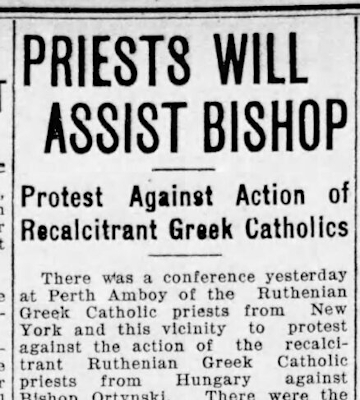
Perth Amboy Evening News (Perth Amboy, New Jersey), 1912-09-04
As happened in many of the newly established Ruthenian communities in the U.S., differences from the Old Country were magnified and led to major conflict in the New World. The first Ruthenians came to Perth Amboy from Transcarpathia (which was under the control of Hungary in the Austro-Hungarian Empire) around 1884. The Transcarpathians lived on the Western Slopes of the Carpathian Mountains and spoke a different dialect from the Galicians who lived on the Eastern Slopes of the Carpathians.Assumption of the Blessed Virgin Mary Ukrainian Catholic Church, 1908-1983, in History of Ukrainians in Perth Amboy. Editor, Alexander Lushnycky, PhD. 1984. pp. 65. And so although the two Ruthenian groups initially were united in the parish of St. John the Baptist Church on Broad St. in 1896, they eventually separated by 1908 the Galician-Ruthenian group formed the Assumption of the Blessed Virgin Mary (Ukrainian) Catholic Church.
The Composition of the Local Community
The Galician Ruthenians who arrived in Perth Amboy after the Transcapathians came from the regions of Sanok, Lisko, Peremyshl, Dobormil and Rohatyn. There was a large group from the village of Cherche (near Rohatyn). They comprised half of the parishioners of Assumption Church in its early days. The Cherche group were very pro-Ukrainian and this attitude put its mark on Assumption parish and the local Ruthenian community.History of Ukrainians in Perth Amboy. Editor, Alexander Lushnycky, PhD. 1984. pp. 68-69.
The first Ruthenians in Perth Amboy resided along the railroad tracks in the northeastern section of the city. They worked in iron and steel works, factories producing roof shingles, and asphalt and other manufacturing companies. Some also found work on nearby farms. By 1910, Eastern Europeans had grown to sufficient numbers to warrant a discussion in the local press (The Perth Amboy Evening News) regarding whether additional categories should be in the Federal census and include the variety of Slavic people who were now in the U.S. (and it included Ruthenians).
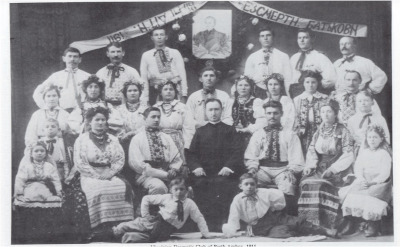
Ukrainian Dramatic Club of Perth Amboy
State Street became an important community hub, with its Ukrainian Hall and picnic grounds at number 762. The local press (The Perth Amboy Evening News) provided good coverage of activities and events in the local community calling the residents “Ruthenians” early on and “Ukrainians” beginning in the 1920s. By the middle of the 1930s, there were 460 families (a total of 3,000 people) active in 15 organizations, including a “American-Ukrainian Democratic Club” with its own “People’s Club”. The house, worth $15,000, housed almost all Ukrainian societies and a library.”Jubilee Book of the Ukrainian National Association in Commemoration of the Fortieth Anniversary of Its Existence. Svoboda Press, Jersey City, N.J., 1936. p. 618.
Ukrainians opened many businesses that served the local community. In 1936, there were 21 Ukrainian enterprises: 4 grocery stores, 6 hotels, 2 barber shops, 1 tailor, 1 dyer, 2 builders, 2 undertakers and 3 transport companies. Ukrainian professionals included one lawyer, three pharmacists, two music teachers, and one public school teacher. Thirteen Ukrainians worked in Perth Amboy City jobs.Jubilee Book of the Ukrainian National Association in Commemoration of the Fortieth Anniversary of Its Existence. Svoboda Press, Jersey City, N.J., 1936. p. 618.
Ukrainian Perth Amboy Today
Although the ethnic makeup generally and the Ukrainian community specifically has changed dramatically since the 1930s, the Assumption of the Blessed Virgin parish is still very much functioning. It continues to have a primary school, and it has had an annual tradition of hosting a Ukrainian Cultural Festival.